
An e-cart and an e-rickshaw may share a battery-powered three-wheel layout, but they are built for different jobs and create different training risks. By comparing their design, legal status, daily work and practical lessons, you can select training that matches the vehicle you will actually operate in Noida.
Key takeaways
- Choose e-rickshaw training for passenger routes and e-cart training for goods work.
- Check the vehicle’s 25 km/h, 2 kW and 310 kg limits before enrolment.
- Practise battery charging, braking, reverse control and load stability—not steering alone.
- Ask for registration, insurance, licence and permit guidance for Uttar Pradesh.
E-Cart or E-Rickshaw: What Is the Actual Vehicle Difference?
In Indian transport terminology, the road-going goods vehicle is usually an e-cart, not an e-kart. It is a battery-operated three-wheeler limited to 25 km/h, with motor power up to 2 kW and rated carrying capacity up to 310 kg excluding the battery.
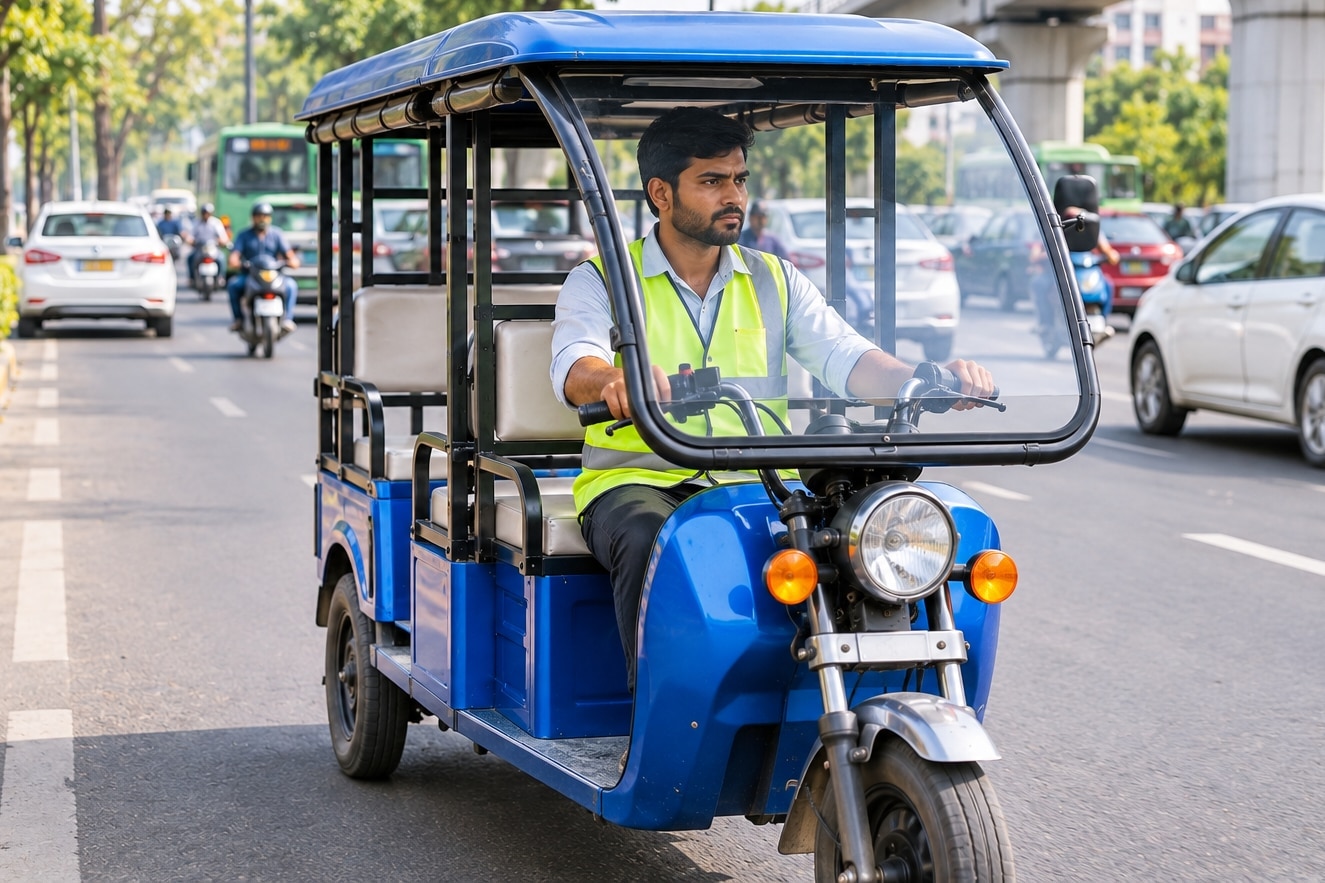
An e-rickshaw has the same basic speed and motor-power limits but carries up to four passengers besides the driver.
| Vehicle | E-cart | E-rickshaw |
|---|---|---|
| Body | Open or enclosed cargo platform | Passenger cabin, side access and seats |
| Driving layout | Handlebar or steering wheel, with the driver positioned around the front or cargo load | Handlebar or wheel, with the driver ahead of the rear passenger bench |
| Handling | Rear-axle load changes turning radius, track behaviour and braking response | Passenger movement changes balance, turning radius and braking response |
Compare those features on the actual training vehicle, not from a brochure. Both have a short wheelbase and relatively high centre of gravity, so diagonal kerb crossings, abrupt steering and overloading can cause instability.
For anyone comparing driving school e kart training versus e rickshaw training noida, ask for:
- Manufacturer classification, registration certificate and number plate
- Permitted use and insurance
- Confirmation that the vehicle is road-going
A low-speed cart inside a warehouse, resort, campus or private delivery route is not automatically legal on public roads. A recreational electric go-kart or generic battery cart is not necessarily an e-cart. An e kart driving school noida listing proves nothing until it identifies the vehicle category.
Which Training Matches Passenger Work, Cargo Work and Site Driving?
Choose e-rickshaw training for public-road passenger transport; choose e-cart training for cargo work in a warehouse, campus, resort, market or delivery operation. This e rickshaw training comparison shows why the courses are not interchangeable.
| Option | Work | Training priority |
|---|---|---|
| E-rickshaw | Passengers on public roads | Passenger safety and roadside interaction |
| E-cart | Cargo on a specific cart and route | Load restraint, reversing and confined-area control |
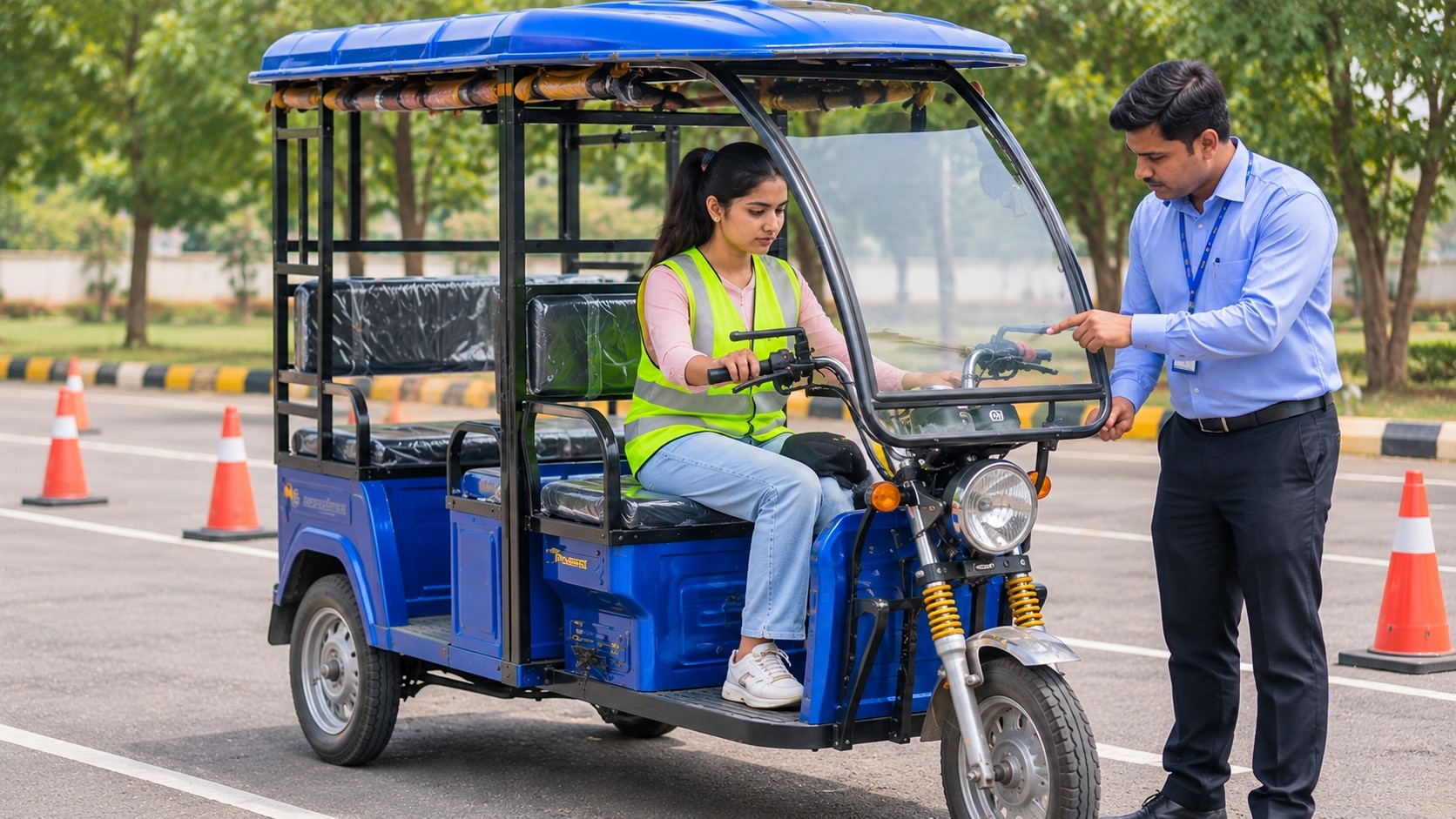
An e-rickshaw lesson must include mounting and dismounting, safe kerbside stops, mirror and blind-spot checks, junctions, mixed traffic, pedestrians, night visibility, hill starts, emergency braking and parking.
Passenger practice must cover boarding from the safe side, balance during turns, overloaded seating, loose baggage, schoolchildren, wheelchair or mobility-aid handling, and stopping where passengers can enter without stepping into traffic.
Refuse standing passengers, passengers leaning outside, or cargo that blocks your view. A driver who accepts unsafe loading has created a control problem before the vehicle moves.
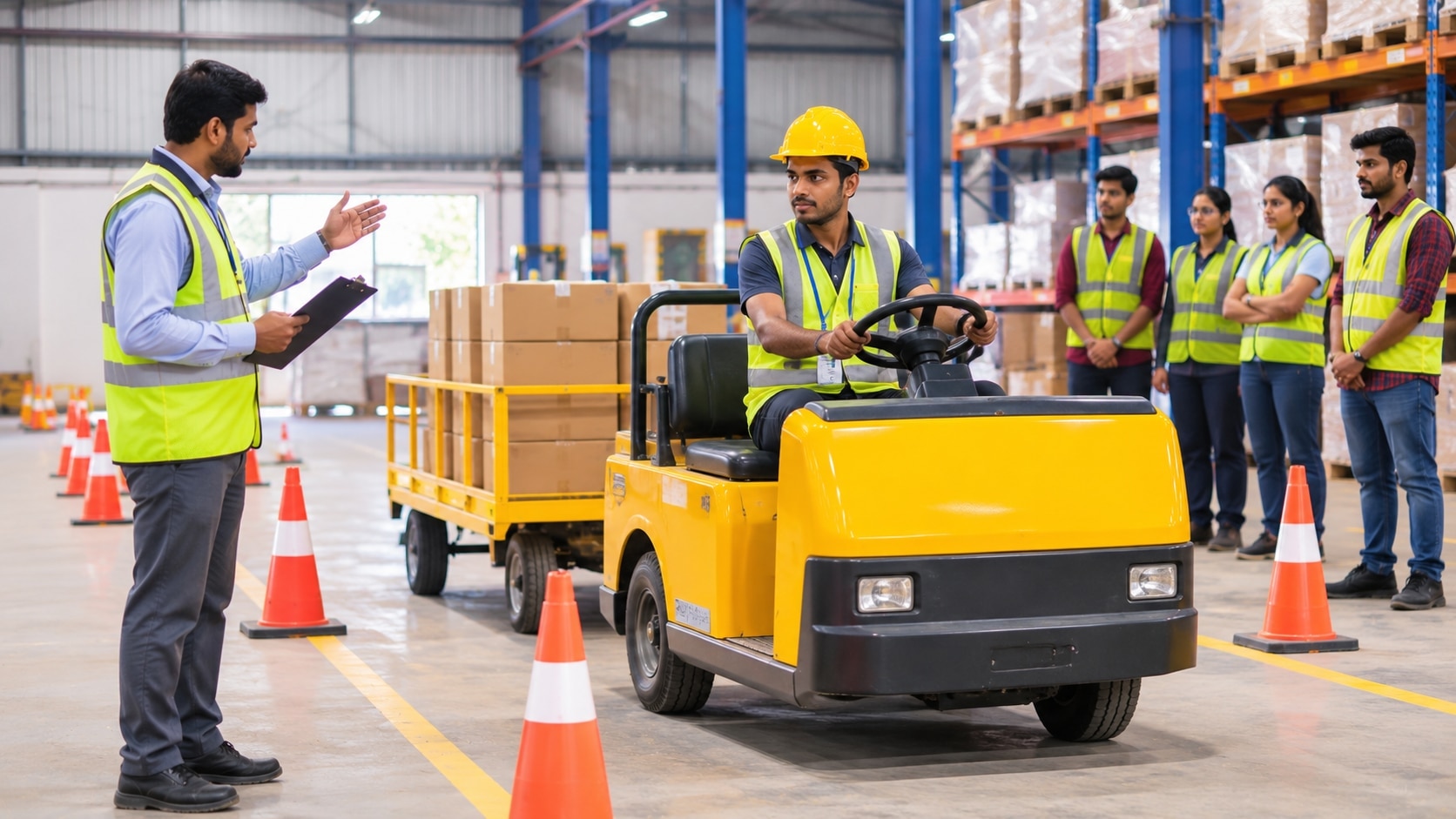
E-cart training must use the exact cart and include cargo inspection, securing restraints, even rear-axle loading, reversing toward a loading bay, tight loaded turns, narrow-site manoeuvring, pedestrian separation and delivery-route parking. Require both empty and loaded sessions: weight changes acceleration, steering, stopping distance and range.
E-cart training does not prepare you to carry e-rickshaw passengers, while e-rickshaw training does not automatically teach cargo restraint or confined-area reversing. An electric vehicle driving school is suitable only if it trains the exact three-wheeler category and work environment you will use.
What Battery and Control Skills Should the Lessons Include?
1. Before moving, follow the key-on sequence while the vehicle remains stationary. Check the direction selector, parking brake, tyres, mirrors, lights, horn, cables, connectors and visible battery damage. Select drive or reverse only after the vehicle is secure; an electric motor can respond immediately and quietly.
2. Practise smooth accelerator release and controlled regenerative braking, then warn pedestrians at low speed with the horn or voice. Repeat emergency stops without losing steering control or locking the vehicle into an uncontrolled skid. Include loaded e-cart practice because cargo changes acceleration, stopping distance, steering response and range.
3. Charging instruction must identify the manufacturer-approved charger, matching connector and required charging location. Keep that area dry, ventilated and free of combustible material; never use damaged plugs, improvised extensions or wet connectors. Stop operation, isolate the vehicle where instructed and report a battery that is unusually hot, swollen, damaged or producing an unfamiliar smell.
Avoid water around electrical connections.
4. Teach parking on stable ground, securing the vehicle and responding to battery warnings before power disappears in traffic. Treat the dashboard range estimate as a planning aid, not a promise: passengers or cargo, gradients, under-inflated tyres, repeated stops, lights and fans reduce usable range. Plan a reserve.
An electric vehicle driving school should assess these controls on the same e-cart or e-rickshaw category you will operate.
What Legal Checks Apply Before You Drive in Noida?
A course certificate does not authorise you to drive on a public road. A search for driving school e kart training versus e rickshaw training Noida options must begin with the vehicle’s legal identity, not the school’s advertising.
1. Read the registration certificate and manufacturer classification. Confirm whether the vehicle is a road-going e-cart, e-rickshaw or private-site vehicle. Do not assume a recreational go-kart or battery cart is road-legal.
2. For public-road use, check the registration, number plate, insurance and applicable fitness or roadworthiness documents. A driving lesson in an unregistered training vehicle proves control skills, not compliance for your own vehicle.
3. If you will carry passengers, verify the operator’s driving-licence class, learner-licence requirement, test process, minimum age, any badge requirement, vehicle permit, route conditions and local traffic restrictions. A driving licence alone does not authorise paid passenger service.
4. For goods work, ask which registration, permit and operating conditions apply to that e-cart and route. Private-site driving follows a different route, but you still need site permission, pedestrian controls and cargo-safety training.
Confirm the exact licence class, test location, age rule and required documents through the Uttar Pradesh Transport Department or Parivahan before paying. Ask the authority or school to identify them in writing.
How Do You Compare an E-Kart and E-Rickshaw Course in Noida?
Do not pay for an “e-kart” course until you know what that word means. Ask whether it covers a registered road-going e-cart, a recreational go-kart or a generic electric three-wheeler. Request the training vehicle model, registration class, permit category and proof that its controls and dimensions match the vehicle you will drive.
| Option | Training focus | Evidence to request |
|---|---|---|
| E-rickshaw | Passenger loading, safe stopping and smooth junction starts | Public-road traffic practice with passengers or a loading simulation |
| E-cart | Cargo inspection, restraint and turning under load | Loaded and empty sessions, confined-area reversing and loading-bay practice |
| Recreational go-kart | Track control and leisure driving | Confirmation that it does not substitute for road-going e-cart training |
A useful e rickshaw training comparison measures actual practice, not certificate names. Ask for:
- Hours driving, hours in traffic and the instructor-to-student ratio
- Loaded and empty practice, plus reversing time
- Charging, fault reporting and battery-warning instruction
- A timed or observed emergency-stop assessment
- E-rickshaw checks for pedestrian clearance, passenger loading and safe kerbside stopping
- E-cart checks for load restraint, rear-axle loading and turning with cargo
The phrase electric vehicle driving school is too broad if the centre mainly teaches cars or scooters. For an e kart driving school noida search, verify these details directly. Om Sai Motor Driving Training School belongs on your shortlist only after you confirm the vehicle documents and practical hours.
Choose e-rickshaw training for passenger work; choose e-cart training for a specific cargo cart and operating site.
Related services
E-Rickshaw Training Om Sai Motor Driving Training School offers specialized E-Rickshaw Training designed for safe, efficient, and professional driving. View service → |
E-Kart Training Om Sai Motor Driving Training School offers specialized E-Kart Training designed for beginners and professionals entering the electric cart and... View service → |
Frequently asked questions
What is the difference between an e-cart and an e-rickshaw?
An e-cart is a battery-operated three-wheeler designed mainly for goods, with a maximum speed of 25 km/h, motor power up to 2 kW and rated carrying capacity up to 310 kg excluding the battery. An e-rickshaw is configured mainly to carry passengers, with different seating, access and load-control needs.
Which training suits passenger work, cargo work or site driving?
Choose e-rickshaw training for passenger boarding, stop-start routes, safe turning with occupants and smooth braking. Choose e-cart training for loading, unloading, reversing, corner clearance and cargo stability. Site driving requires practice on narrow lanes, ramps, uneven surfaces and pedestrian-heavy areas.
What battery and control skills should electric three-wheeler lessons include?
Lessons should cover charger use, charging-point safety, battery warning signs, range planning, accelerator control, regenerative or service braking, reverse manoeuvres, parking and safe load distribution. Ask whether training uses the same control layout as your intended vehicle.
What legal checks apply before driving an electric three-wheeler in Noida?
Confirm the vehicle’s registration certificate, insurance, number plate, approved vehicle category, permitted use and any required permit or fitness documents. Carry the correct driving licence and ask the training school to explain current Uttar Pradesh transport requirements for that exact model.
How do you compare an e-cart and e-rickshaw course in Noida?
Compare vehicle type, supervised road hours, cargo or passenger exercises, battery instruction, reverse practice, emergency braking, document guidance and instructor feedback. Reject a course that teaches only basic steering without testing the work you intend to perform.