
A warehouse e-kart operator must do more than steer a low-speed vehicle. The right course matches the exact cart to the site, teaches safe movement around pedestrians and loads, and tests practical competence rather than attendance alone. By the end, you will know which course details to verify before enrolling or assigning a worker.
Key takeaways
- Match training to the e-kart’s payload, controls, brakes and permitted routes.
- Require demonstrations of reversing, cornering, pedestrian safety and load stability.
- Include pre-use checks, battery isolation, charging controls and defect reporting.
- Accept completion records that identify the machine, operator, assessment and trainer.
Which vehicle and warehouse routes should the course cover?
Before training starts, identify the exact machine and where it may operate. “E-kart” can mean a utility cart, platform truck, electric tug, powered pallet truck or road-going vehicle, each with different controls, rated payload, turning radius, braking system and permitted operating area.
| Vehicle type | Training focus | Warehouse implication |
|---|---|---|
| Utility cart | Steering, braking, payload and passenger restrictions | Stock movement on authorised internal routes |
| Platform truck | Platform loading, stability and visibility | Use only within its rated payload |
| Electric tug | Coupling, towing capacity and stopping distance | A carrying cart is not automatically rated to tow |
| Powered pallet truck | Forks, tiller controls and load stability | Separate from forklift qualification |
| Road-going vehicle | Road controls, registration and operating boundary | Indoor-cart training does not authorise road use |
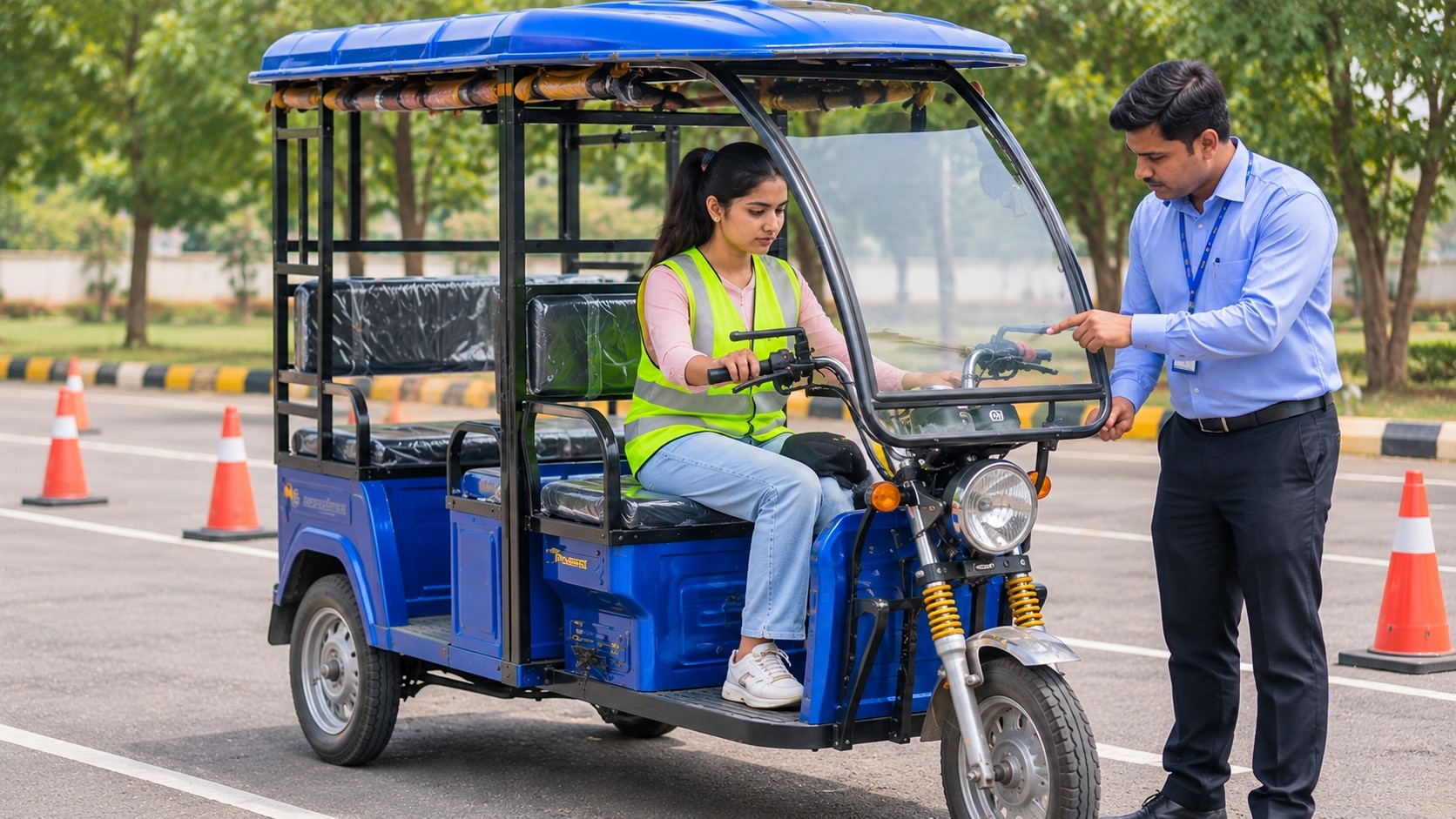
An e kart driving school course for warehouse work noida should use the same vehicle, or an equivalent model, inside a warehouse layout rather than only on open ground.
Warehouse e kart training must trace receiving, storage, picking, packing and dispatch routes, including rack aisles, crossings, blind corners, dock edges, ramps, loading bays, emergency exits, charging areas, restricted zones, speed limits and parking locations. Marked walkways, barriers, controlled crossings, mirrors and warning systems must separate pedestrians from vehicles.
Yield to pedestrians; a horn warns people but does not authorise entry into a crowded aisle. An e-kart does not replace forklift training: forks, mast movement, load charts and stacking require separate instruction on the relevant forklift.
What driving and load-handling skills should an operator demonstrate?
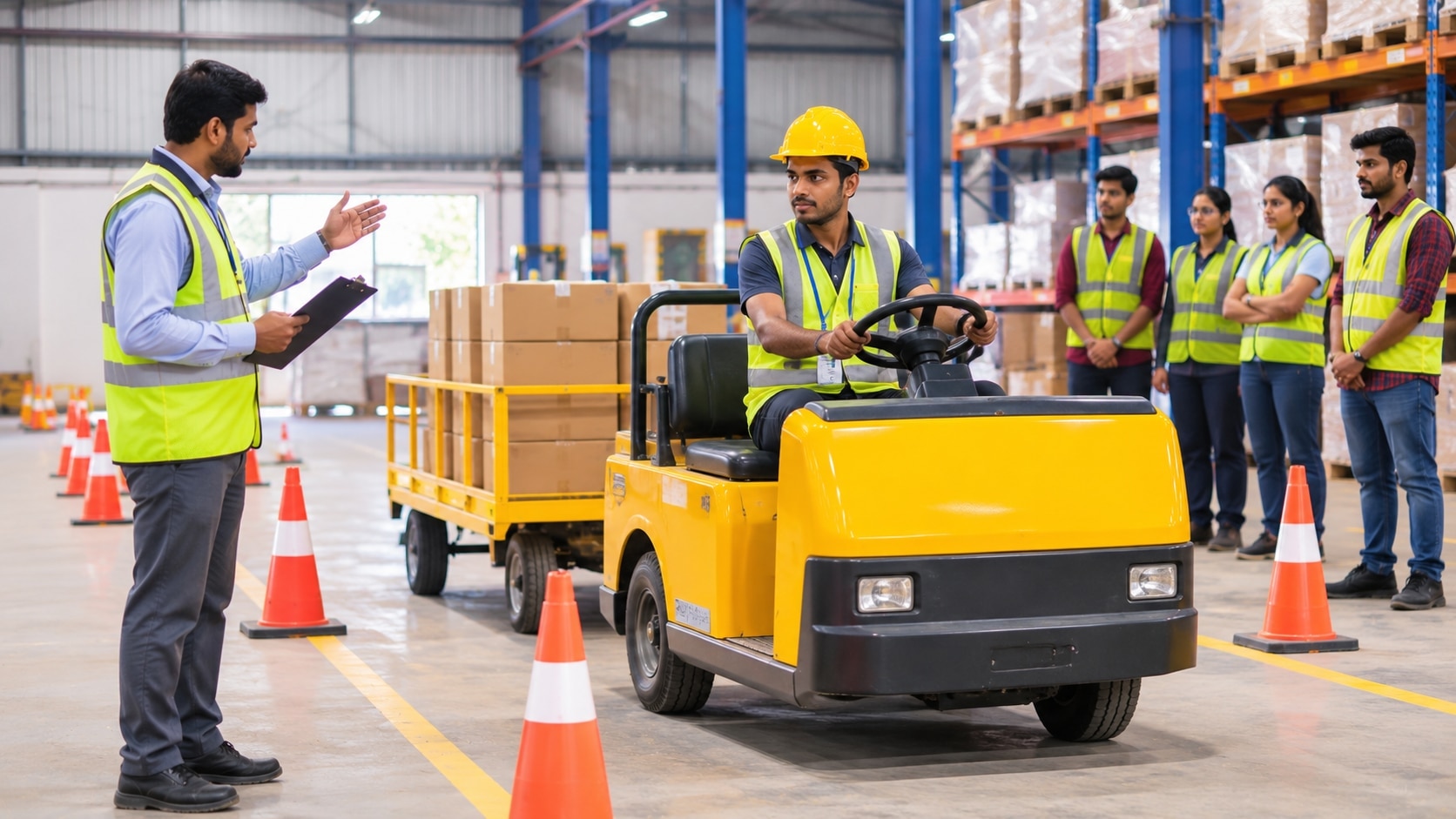
After site orientation, the operator must demonstrate controlled driving and load handling in the actual warehouse layout, not merely attend a classroom session. Electric kart operator training should assess these practical tasks:
1. Start and stop smoothly, control speed, reverse with a clear view or required spotter, make wide-clearance turns, stop safely on ramps, and maintain distance from racks and dock edges.
2. Position the vehicle at loading points and couple a trailer or tugger when the job requires it. A cart rated to carry stock is not automatically rated to tow a trailer.
3. Read the data plate and manufacturer’s rated capacity, then move a load within that limit. Distribute weight evenly, secure cartons, keep the centre of gravity low, and stop work when a load is unstable, oversized or blocks forward visibility.
4. Use an approved alternative route or travel direction when the load hides the view. Never carry a person on a platform, tow hitch or load area unless the vehicle is designed and approved for passengers.
5. Practise controlled responses to brake or steering loss, a blocked route, collision, pedestrian near miss, runaway or rollaway, battery smoke, vehicle immobilisation and a loading-dock approach. The operator must stop, isolate or secure the vehicle, warn others, summon help and report the event.
A warehouse e kart training assessment should record each result under controlled conditions; repeated emergency driving without a safe training area creates another hazard.
What inspection, battery and charging procedures belong in the course?
Before each shift, the trainee must complete and record a pre-use inspection before driving. In e kart training Noida, this record matters because a defect passed to the next operator can cause a collision, loss of control or battery incident.
- Check tyres or wheels, steering, service and parking brakes, accelerator return, horn, lights or beacon, and reverse alarm where fitted.
- Check guards, seat belt or restraint, battery condition, charging connector, leaks, visible damage and the data plate showing rated load.
- If anything fails, isolate the vehicle, mark the defect and report it. Do not rely on the next driver to notice it.
Battery instruction must identify the chemistry because controls differ:
| Battery type | Main risks and controls | Operator response |
|---|---|---|
| Lithium-ion | Swelling, hissing, heat, smoke, leakage or impact damage | Stop, keep people clear, notify the responsible person and follow the emergency procedure |
| Lead-acid | Acid spill, hydrogen gas and charging fumes | Use the site’s spill, ventilation and ignition-control procedure |
Electric kart operator training must require the specified charger only. Park and switch off before connecting, inspect cables and connectors, keep metal objects away from terminals, maintain ventilation, exclude ignition sources and obey charging-zone rules. A battery that will not accept a charge also requires immediate withdrawal from service.
Do not open or repair a pack. Isolate a smoking, leaking, unusually hot or damaged vehicle, warn others and summon help under the site procedure.
How should the course measure competence and document completion?
A short class does not prove warehouse competence. Ask an e kart driving school noida provider for the total course length, classroom time, supervised practical hours, maximum class size, minimum age, entry requirements, identity documents, available language options and whether practical training uses a warehouse layout rather than open ground.
Request written answers to these points:
- Does the assessment record inspection, controlled starts and stops, route-following, speed control, pedestrian yielding, safe reversing, rated-load handling, secure parking and simulated-defect reporting?
- Does it include a battery or charging-safety check and an emergency scenario involving a blocked route, collision, loss of brakes or steering, rollaway, battery smoke or loading-dock risk?
- Who assesses the learner, and does the record show each pass, fail, observation and corrective action?
- What exact document follows a pass: a dated competence record naming the vehicle, payload and assessed tasks, or only an attendance certificate?
Sound electric kart operator training combines a written or oral safety check with observed driving. A car licence, classroom attendance or experience on another machine does not prove e-kart competence.
The employer still controls site induction, authorised routes, supervision, maintenance rules and charging arrangements. It must arrange refresher training after an incident, unsafe observation, equipment change or long gap in use. A school document proves instruction, not blanket permission for every powered warehouse vehicle.
How can you compare e-kart courses for a Noida warehouse?
Choose by job-specific evidence, not course length: the right e kart driving school noida course proves competence on the vehicle and routes your warehouse actually uses.
| Check | Acceptable answer | Warning sign |
|---|---|---|
| Vehicle | Same make and model, or an equivalent with the same controls, payload, turning radius and braking system | “E-kart” is the only description |
| Practical test | Loaded run, reversing, blind corners, pedestrian crossings, ramps, dock approaches, restricted zones, secure parking and a simulated defect report | Open-ground driving only |
| Course record | Named trainer and assessor, class size, practical hours, languages, assessment standard and an exact completion document | Attendance certificate without assessed tasks |
| Battery | Named chemistry, such as lithium-ion or lead-acid, plus the charging procedure for that battery | Generic “battery care” advice |
Ask for written answers before booking. Confirm whether the assessment records the vehicle, rated payload and operating limits, then check that the employer can map it to the site traffic plan, authorised routes and operating rules.
Also ask what the course excludes. Forklift lifting, road driving, towing and passenger transport require separate instruction unless the provider assesses those tasks on suitable equipment. A forklift qualification cannot be inferred from cart driving, and a cart certificate cannot authorise every powered warehouse vehicle.
Om Sai Motor Driving Training School belongs in the comparison only after it answers these same questions for the employer’s site. That is the standard for an e kart training noida provider and an e kart driving school course for warehouse work noida.
Related service
E-Kart Training Om Sai Motor Driving Training School offers specialized E-Kart Training designed for beginners and professionals entering the electric cart and... View service → |
Frequently asked questions
Which vehicle and warehouse routes should an e-kart course cover?
The course should use the exact e-kart at your site and cover its controls, rated payload, turning radius, braking system, loading areas, aisles, ramps, crossings, pedestrian zones and restricted routes.
What driving and load-handling skills should an operator demonstrate?
The operator should demonstrate controlled starting and stopping, steering, forward and reverse travel, cornering, visibility checks, horn use, pedestrian separation, safe loading, load security and operation within the rated capacity.
What inspection, battery and charging procedures belong in e-kart training?
Training should cover pre-use inspection of tyres, steering, brakes, lights, horn, forks or platform, guards and damage; battery condition and isolation; charger connection; ventilation; charging zones; and defect reporting.
How should an e-kart course measure competence and document completion?
Use a written knowledge check and observed practical assessment against defined pass criteria. Record the operator’s name, machine type, assessment date, trainer, result, restrictions, remedial actions and refresher date.
How can you compare e-kart courses for a Noida warehouse?
Compare courses by machine-specific practice, route simulation, load-handling assessment, battery and charging instruction, trainer competence, assessment records, refresher arrangements and alignment with your warehouse hazards.