
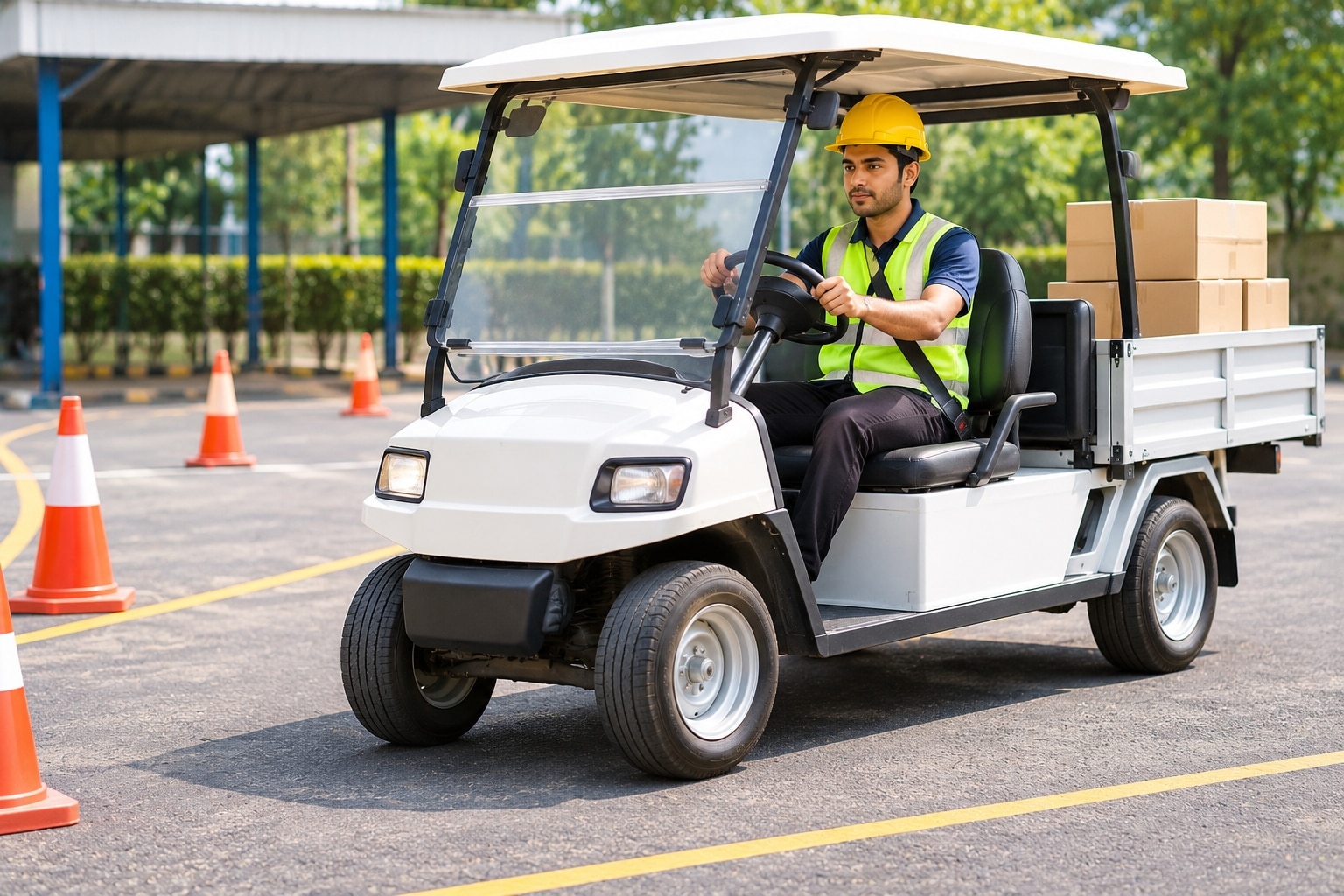
Harsh starts, late braking, rack impacts and pedestrian conflicts usually point to a mix of operator technique, vehicle condition and poorly controlled routes. You will learn how to identify the real cause, control an E-Kart at low speed, work safely with loads and batteries, and choose workplace training that matches the vehicle and site.
Key takeaways
- Change one driving variable at a time before blaming the operator.
- Practise walking-speed control for aisles, ramps, loading bays and public routes.
- Match load, passenger limits and route conditions to the E-kart type.
- Record battery condition, defects and repairs before each shift.
Why Daily E-Kart Driving Problems Keep Happening at Work
A repeated mistake is not proof of poor driving. Diagnose it by changing one variable at a time: keep the route constant, observe the same manoeuvre with another trained operator, and use a different E-Kart where possible. Record speed, braking, steering, visibility and the vehicle’s condition before blaming the person.
- Skill problem: the error follows the operator across vehicles and routes, such as harsh starts, late braking or oversteering in a clear aisle. A practical assessment exposes the missing control.
- Vehicle fault: the error follows one cart, such as pulling to one side, weak brakes, damaged tyres, poor steering return or reduced visibility from a faulty mirror. Remove that E-Kart from service and record the defect.
- Work-system problem: several operators make the same mistake at a blind corner, loading bay, ramp or pedestrian crossing. Treat it as a route-design or traffic-control failure, not a coaching failure.
Warehouse driving problems become predictable when pedestrians share unmarked lanes, queues block sightlines, horns replace separation and wet concrete is left uncontrolled. Review near-miss reports, collision locations and route changes with the operator.
A driving school for e-kart workplace driving problems noida should provide an employer-specific assessment, a vehicle-specific checklist and follow-up observation in the warehouse or campus. Retraining is appropriate after a collision, near miss, unsafe shortcut, changed route, different E-Kart or failed evaluation; it cannot fix a dangerous layout by itself.
Low-Speed Control for Aisles, Ramps, Loading Bays and Public Routes
Keep the E-kart at walking pace wherever pedestrians, racks or blind corners share the route. Feather the accelerator instead of stabbing it, release power before the turn, and apply the brake before steering; turning while braking late causes understeer, corner strikes and harsh stops.
Use one repeatable control sequence: look through the intended path, lift off the accelerator, brake in a straight line, turn with small steering inputs, then accelerate only after the wheels are straight.
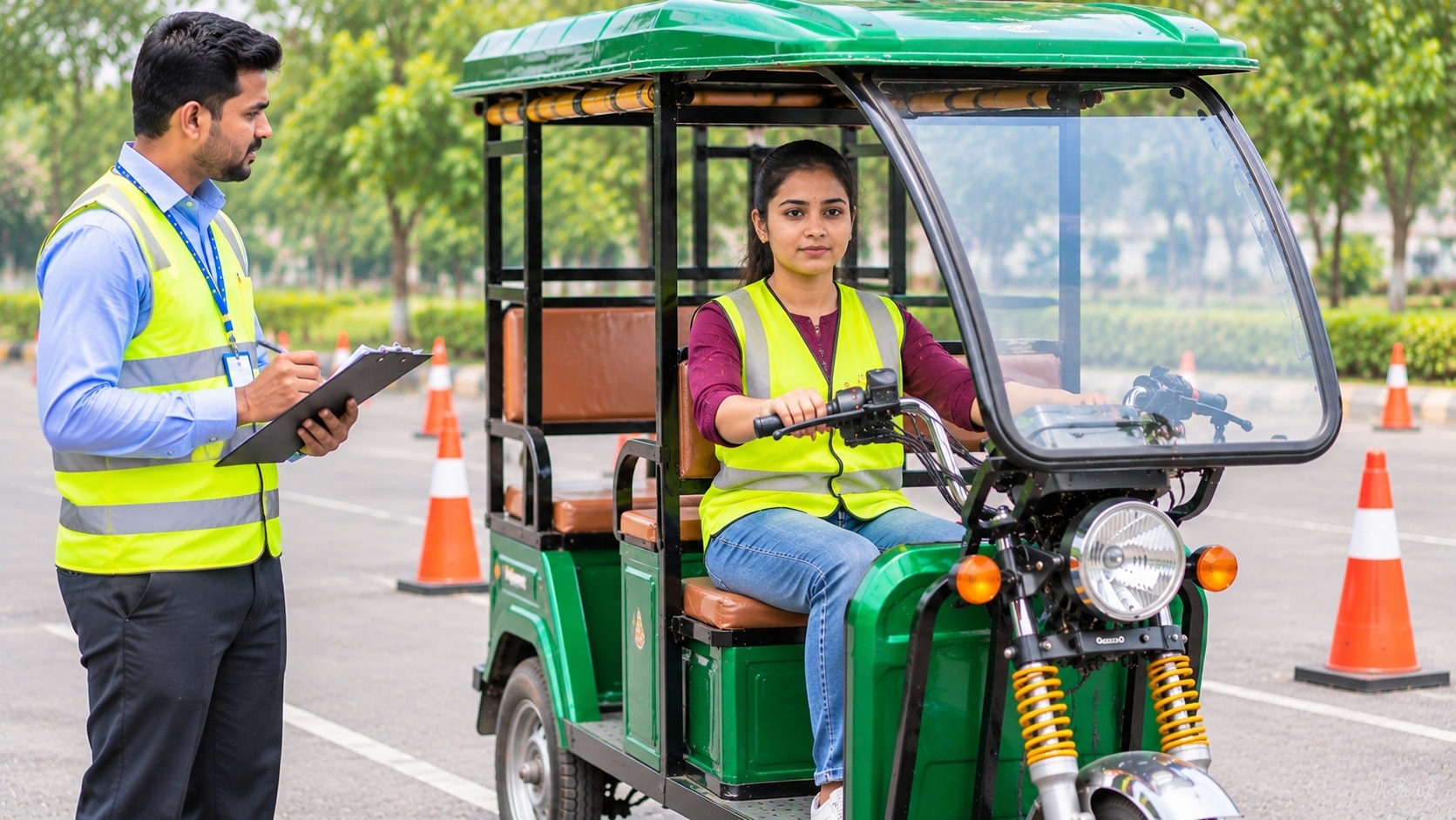
Practise it in the actual workplace route during e kart operator training, because a cart’s response changes with load, slope, surface and regenerative braking.
- Aisles: Keep enough clearance from racks to stop without reversing. Stop before a blind intersection, sound the warning device if site rules require it, and proceed only when the cross-aisle is clear.
- Ramps: Approach straight, reduce speed before the slope, and avoid abrupt accelerator changes. Do not coast blindly; loss of traction or braking on a wet ramp can carry the cart into a gate or pedestrian.
- Loading bays: Stop short of dock edges, wheel stops and open shutters. Confirm the bay is clear before moving around parked vehicles or pallets.
- Public routes: Obey the site’s speed limit, crossings and right-of-way rules. Treat gates and road junctions as stop points, not places to roll through.
Plan to drive forward whenever possible. If reversing is unavoidable, stop, check behind, use a trained spotter when visibility is blocked, and stop immediately if the spotter leaves view.
Electric cart driving help should also include controlled low-battery operation: park safely and report the cart when a fault light appears, or when a battery, cable or interlock is damaged.
Loads, Passengers and the Difference Between E-Kart Types
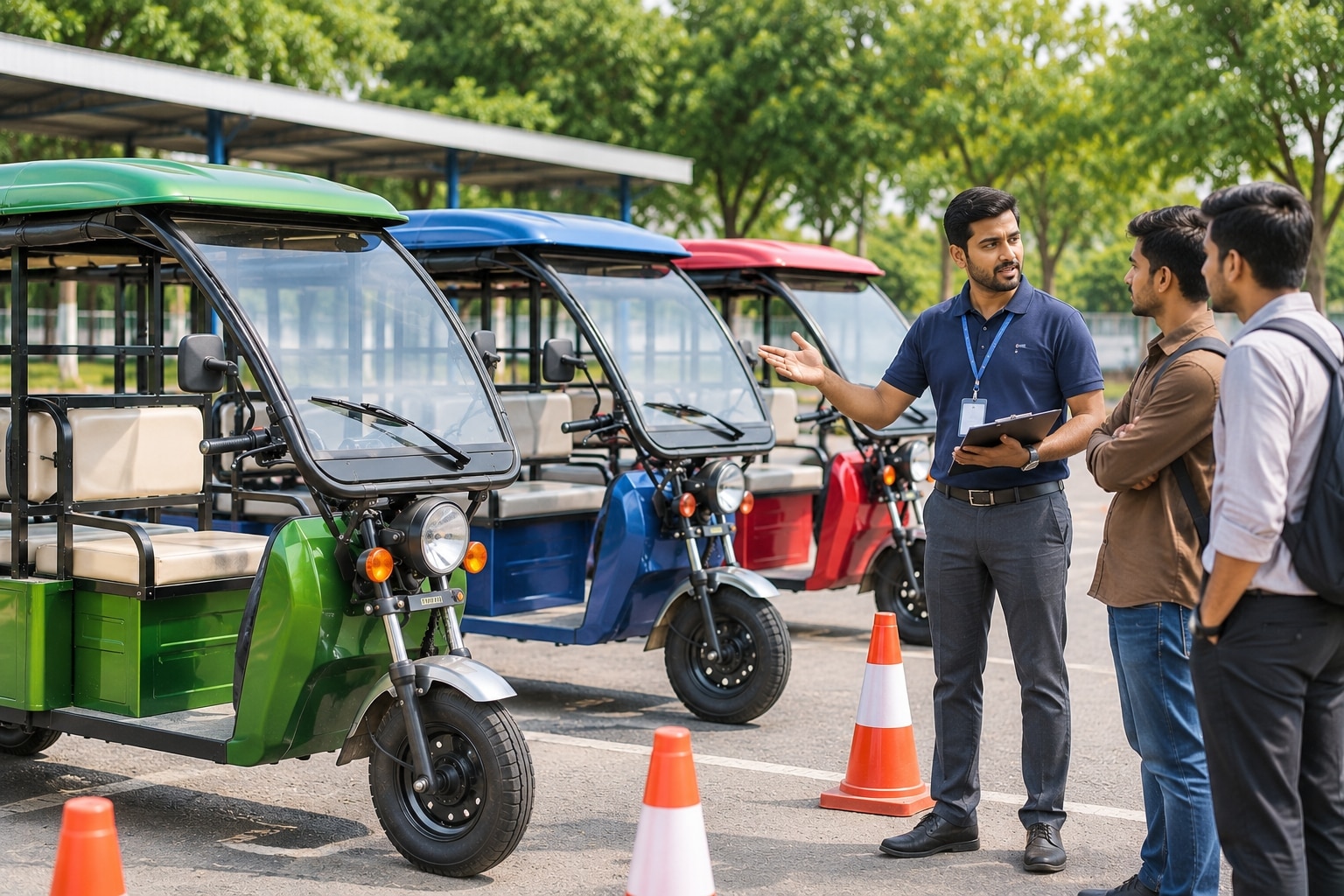
Do not treat every electric cart as the same vehicle. Match the operator’s assessment to the exact wheelbase, steering layout, braking response, visibility, load deck and passenger seating used on the job. A driver competent on a short passenger cart is not automatically competent on a long goods carrier, trailer, forklift-style vehicle or road-going three-wheeler.
| Vehicle type | Load and passenger arrangement | Training match |
|---|---|---|
| Passenger cart | Only the stated number of seated passengers; no standing on steps or rear platforms | Practise passenger loading, smooth starts, turns, braking and pedestrian separation |
| Goods carrier | Rated payload, centred and secured; cargo must not block forward view | Practise load distribution, corner speed, ramp control and parking beside loading points |
| Forklift-style or utility cart | Follow its rated load, attachment and stability limits; keep people outside the load-handling zone | Assess steering, load height, visibility, reversing and pedestrian control |
| Road-going three-wheeler | Approved seating and cargo area; comply with its road-use requirements | Assess marked routes, junctions, mirrors, braking and public-road interaction |
Overloading, a high or offset load and a sharp turn can destabilise a small cart at walking speed. Keep the manufacturer’s payload and passenger limit visible, secure loose goods, and stop if cargo hides the route. Never carry a passenger in an unauthorised position.
Practical e kart operator training must use the operator’s working vehicle and language. Test starting, stopping, controlled turns, parking, charging-point approach, pedestrian interaction and normal load handling. Include route planning that avoids reversing; where reversing is unavoidable, use a trained spotter and stop immediately when that person leaves view.
For e kart training noida, confirm whether the course covers a low-speed passenger cart, goods carrier, site-only utility vehicle or road-going vehicle. Check registration, licence, insurance and RTO requirements with the employer; “e-kart” alone does not establish legal status.
Pre-Shift Checks, Battery Discipline and Defect Reporting
Before every shift, walk around the E-kart and test its safety-critical functions; a signed sheet cannot replace a working check. Confirm steering, service brake, parking brake, tyres or wheels, horn, headlights, brake lights, reverse alarm, mirrors or cameras, seat belt or restraint, battery case, charging connector, cables and visible leaks or damage.
Use this sequence:
- Turn on the vehicle and check warning lights, gauges and safety interlocks before moving.
- Test forward and reverse at walking speed in a clear area; stop immediately if braking, steering or the warning device feels different.
- Check that the battery is secured, dry and free from cracks, swelling, exposed terminals or burning smell.
- Charge only with the manufacturer-approved charger in a dry, ventilated charging area. Do not drive while connected, drag the charger by its cable or use damaged equipment.
- Record the defect, vehicle number, time and your name. Tell the supervisor before taking another cart.
| Condition | Decision | Reason |
|---|---|---|
| Normal controls, intact battery and clear visibility | Release for work | The pre-shift test found no safety-critical defect |
| Low-battery warning or reduced braking assistance | Park safely and report | Power loss can change stopping distance and ramp control |
| Damaged battery, charger, cable, tyre, restraint or interlock | Remove from service | Tag the E-kart and keep it unavailable until repaired and retested |
| Steering, brake, alarm, light or camera failure | Remove from service | Do not rely on a horn or extra caution to solve it |
Clear electric cart driving help targets these checks, while warehouse driving problems require defect reporting rather than another shortcut or rushed trip.
How to Choose Workplace E-Kart Training That Changes Daily Driving
Choose an assessment built around the exact e-kart, load, route and traffic rules your operator uses, followed by workplace observation. A classroom certificate cannot prove control around blind corners, ramps, pedestrian crossings, dock edges, gates, charging points or wet concrete.
Ask the provider to test these points in the language and vocabulary the operator understands:
- Start, stop, turn, brake and park with the normal passenger or goods configuration.
- Plan routes that avoid reversing; where reversing is unavoidable, use a trained banksman and stop immediately if that person leaves view.
- Approach loading bays, ramps, racks, crossings and charging points without harsh acceleration or blocked sightlines.
- Review a recorded near miss, collision or unsafe shortcut, then repeat the failed manoeuvre.
- Identify whether the vehicle is a passenger cart, goods carrier, three-wheeler or site-only utility vehicle, and confirm the employer’s RTO, licence, insurance and operating-area checks.
Use this decision test after the assessment:
| Option | What the evidence shows | Correct response |
|---|---|---|
| Generic lesson | Mistakes are isolated skill gaps on a known route | Deliver vehicle-specific practice, then recheck performance |
| Extra supervision | Unsafe choices continue despite adequate vehicle control | Set a named supervisor, route limits and periodic observations |
| Route redesign | Blind corners, mixed pedestrians, reversing or poor sightlines create repeat hazards | Separate traffic, add mirrors or barriers, mark crossings, or remove the manoeuvre |
A credible e kart training noida provider should record the result and schedule reassessment after a collision, route change or different cart. Om Sai Motor Driving Training School is worth comparing only if its e kart operator training includes that evidence, rather than attendance alone.
For e-kart workplace-driving problems in Noida, route control may solve more than another lesson.
Related service
E-Kart Training Om Sai Motor Driving Training School offers specialized E-Kart Training designed for beginners and professionals entering the electric cart and... View service → |
Frequently asked questions
Why do E-kart driving problems keep happening at work?
A repeated mistake can come from the route, vehicle condition, visibility, speed, braking or steering—not only the operator. Keep the route constant, compare another trained operator, and change one variable at a time.
How can an E-kart operator improve control in aisles and loading bays?
Practise low-speed starts, turns, stops and reversing in the actual workplace. Control speed before ramps and blind corners, maintain clearance, and use a spotter where visibility is restricted.
What should operators check before an E-kart shift?
Check tyres, steering, brakes, horn, lights, mirrors, seat belts, battery charge, cables, leaks and visible damage. Record defects and remove the vehicle from service when a safety-critical fault affects control.
How do loads and passengers affect E-kart driving?
Stay within the vehicle’s stated passenger and load limits, secure cargo, keep weight low and distribute it evenly. A loaded cart needs more stopping distance and handles ramps and turns differently.