
Choosing an e-rickshaw course for Noida route work requires more than comparing fees or counting classroom hours. You will be able to separate legal requirements from training claims, judge practical road exposure, match the vehicle to your intended work, and identify the course that tests the skills local routes demand.
Key takeaways
- Confirm licence, registration, insurance and passenger-route requirements separately.
- Choose hands-on practice covering turns, braking, reversing and passenger stops.
- Ask whether training includes battery charging, range checks and fault reporting.
- Compare total fees, practice hours, route exposure and the final assessment.
Start with the vehicle, licence and route-work baseline
A training certificate does not give you a driving licence, vehicle registration, insurance, or permission to carry passengers on a local route. Confirm those separate requirements before judging any e-rickshaw school.
1. Identify the vehicle you will actually operate: passenger e-rickshaw, cargo variant, or another three-wheeler. Check its control layout, seating, dimensions and battery type, because private-car lessons do not prepare you for its narrow body and open sides.
2. Verify the licence category and minimum age through the current Parivahan process or the local licensing authority. You need the applicable learner’s licence first and the permanent driving licence afterward; commercial e-rickshaw use is not automatically covered by a private-car licence.
3. Ask who will confirm registration, third-party insurance and route or permit authority before paid work begins. An unregistered vehicle cannot legally operate in a public place, and training cannot replace insurance or transport documents.
Match the school to your route baseline: tight turns near kerbs, pedestrian-heavy stops, two-wheelers, passenger loading, low-speed braking and reversing. Ask how the training vehicle handles a low battery and how charging frequency changes with passenger load, traffic, tyre pressure, battery age and gradients; advertised range is not a route plan.
Search results for e rickshaw driving school comparison noida and e rickshaw for driving school comparison noida often mix car, auto-rickshaw and e-rickshaw courses. Compare only schools that name the licence path, vehicle type and local-route practice clearly.
Compare classroom, simulator and hands-on instruction
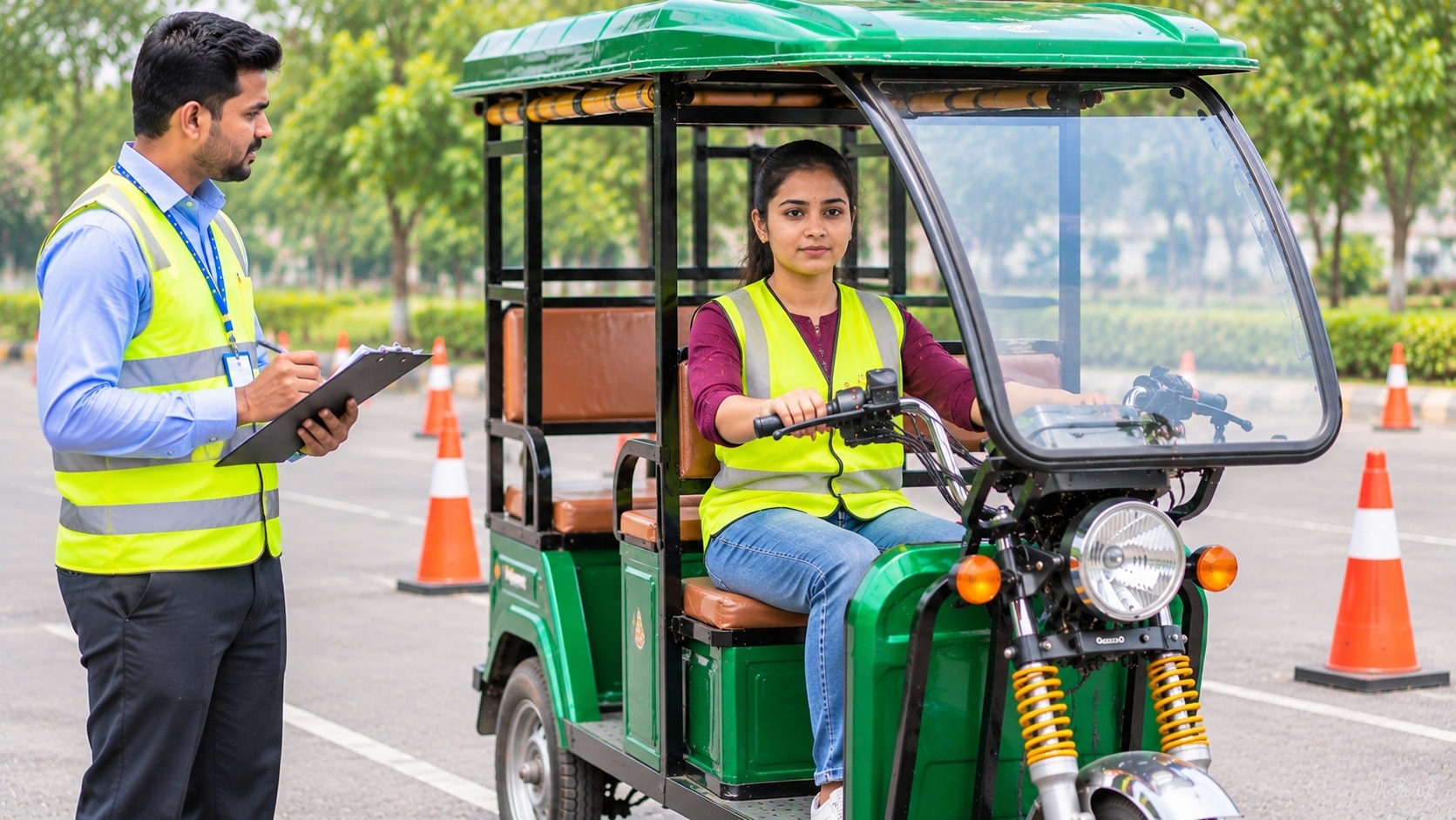
Hands-on instruction prepares you best for e-rickshaw controls and route hazards because you must feel steering resistance, throttle response, braking distance and body movement at low speed. Classroom teaching explains traffic rules, passenger safety and battery precautions, but it cannot show how quickly an open-sided vehicle becomes unstable near a kerb.
| Option | What it teaches | Main limitation |
|---|---|---|
| Classroom | Controls, road signs, right-of-way, passenger loading and emergency procedures | No practice with throttle, steering, braking or real traffic gaps |
| Simulator | Repeated starts, stops, turns, braking and hazard decisions without vehicle damage | Screen feedback cannot reproduce balance, kerbs, passenger weight or crowded-road pressure |
| Hands-on | Vehicle control, tight manoeuvres, hill starts, reversing and supervised route driving | Quality depends on the vehicle, instructor and amount of road time |
Use this compare e rickshaw training checklist before enrolling:
- Confirm practice includes low-speed balance, tight U-turns, reversing beside a kerb, stopping and pulling away on an incline, and emergency braking.
- Ask for supervised driving on both quiet roads and busy market routes, including merging with motorcycles, avoiding pedestrians, loading passengers and moving away from crowded stops.
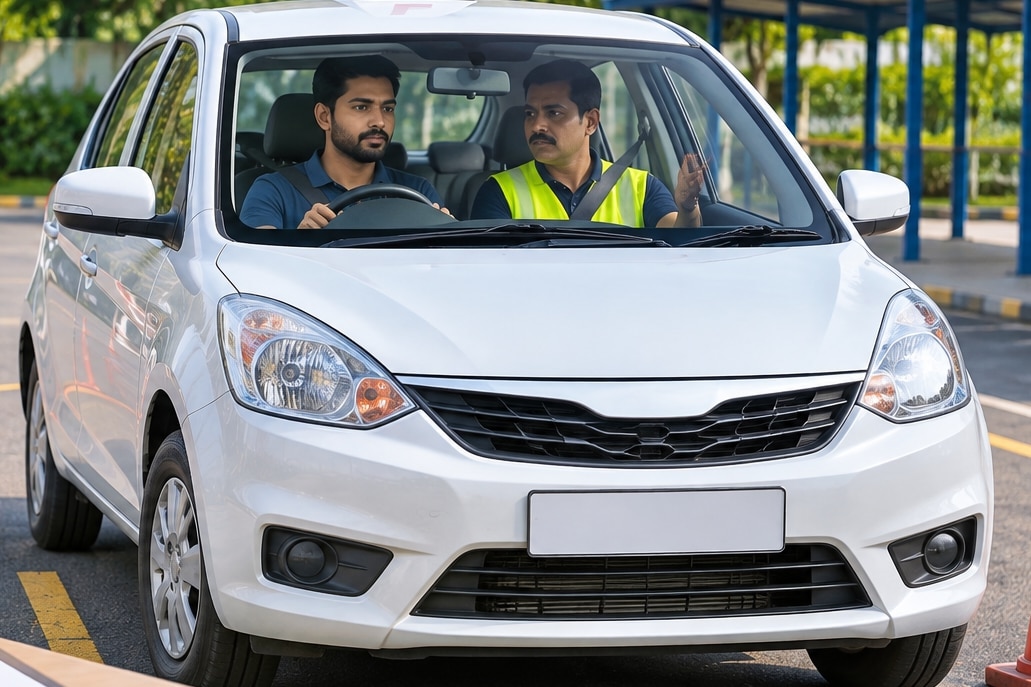
- Reject a course that uses only a car, conventional auto-rickshaw or empty-ground laps. Those exercises leave you unprepared for e-rickshaw steering geometry, narrow clearances and sudden passenger movement.
- Treat simulator time as preparation, not a substitute for driving the actual three-wheeler.
Check whether the vehicle and battery lessons transfer to your work
A course transfers to route work only when its practice vehicle behaves like the one you will drive. Compare the accelerator or throttle response, forward–reverse selector, parking brake, braking feel, steering geometry and battery gauge; a different layout creates hesitation at kerbs, during reversing or among passengers.
Practise on your intended model, not merely a similar three-wheeler.
- Confirm that the training vehicle has the same control positions and battery technology as your work vehicle.
- Ask whether instructors cover charger compatibility, ventilation during charging, and keeping terminals and connectors dry.
- Require practice identifying swelling, overheating, smoke, damaged cables and abnormal smells; isolate a suspect vehicle instead of driving it.
- Ask how the school teaches a safe low-battery response, including when to stop, where to park and whom to contact.
Do not compare advertised range as if it were a route guarantee. Passenger load, stop-and-go traffic, gradients, tyre pressure, battery age, temperature and driving style change distance between charges.
For an e rickshaw driving school noida comparison, ask how often charging occurs during a normal training day and whether battery checks form part of the practical assessment. A road test alone does not prove battery competence.
Measure route exposure, passenger handling and instructor quality
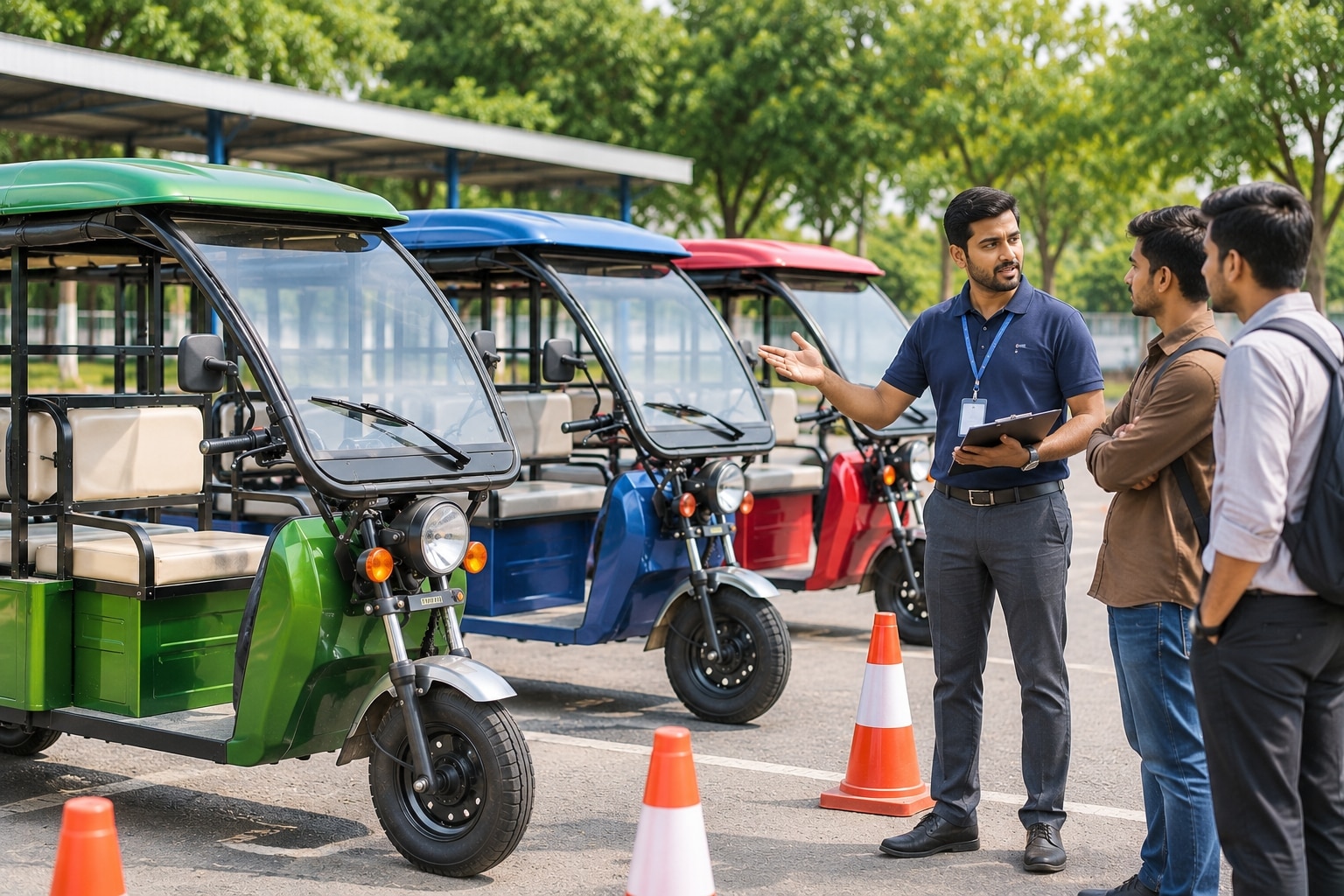
A school prepares you for Noida route work only if its assessment goes beyond moving forward on an empty ground. Ask to observe supervised practice on a quiet road and a busy market route, including legal stopping points, passenger loading and departures beside traffic.
Check whether the instructor watches low-speed control. An e-rickshaw’s narrow, open-sided body leaves little margin beside pedestrians, two-wheelers and kerbs; a weak turn or late brake can put passengers at risk.
During a trial or assessment, require these demonstrations:
- Start and stop smoothly in traffic without rolling backward or jerking passengers.
- Make tight turns, reverse into a confined space and hold correct lane position.
- Perform a hill start and emergency braking while keeping the vehicle stable.
- Pull in, load passengers, secure them and rejoin traffic without cutting across other vehicles.
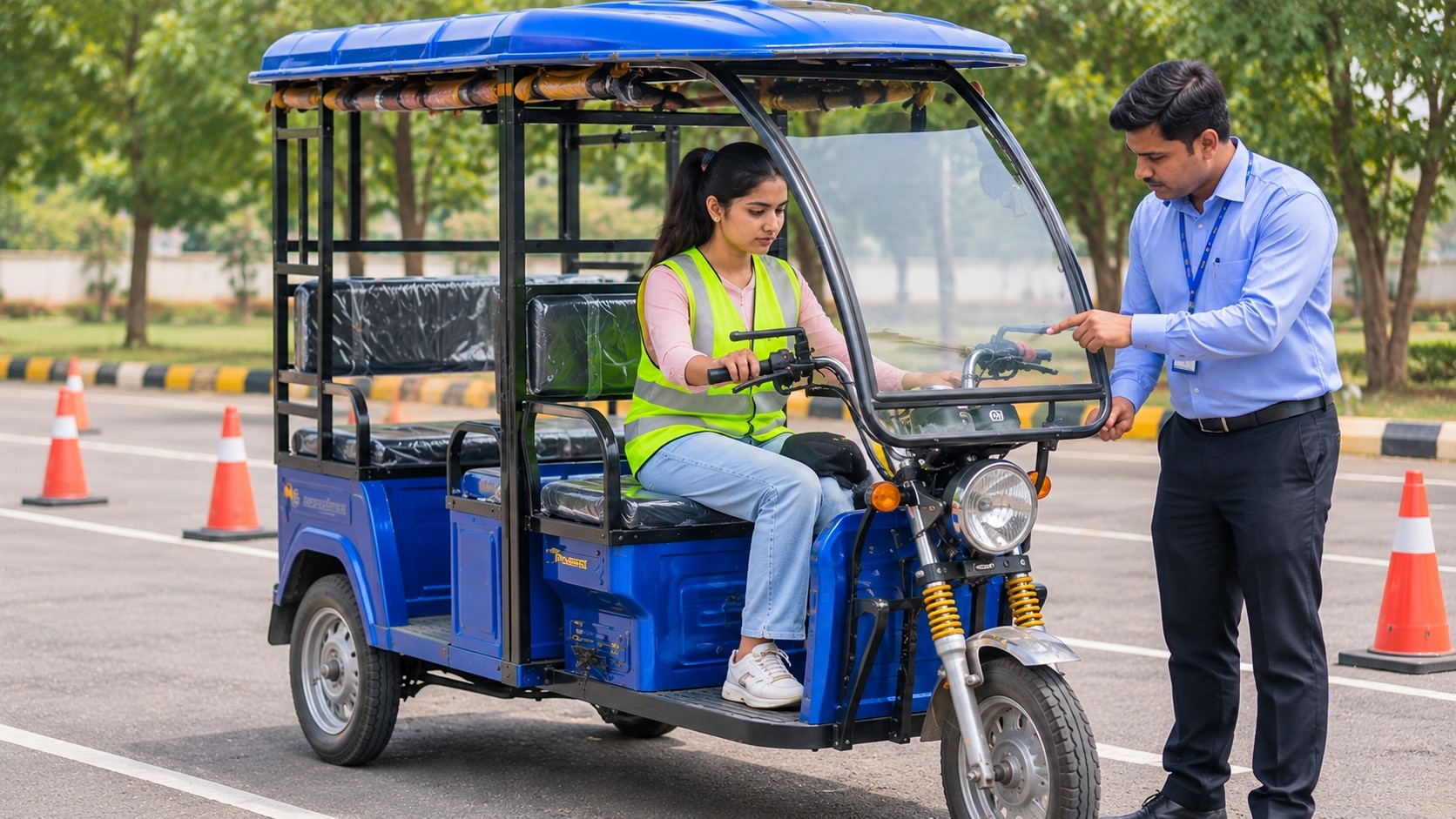
Ask how many road hours are supervised, who sits beside you and whether the same instructor evaluates you. A useful instructor explains throttle response, forward–reverse selection, parking brake and braking feel on the exact vehicle used for training, then corrects your actions rather than taking over.
For e rickshaw driving classes near noida, ask Om Sai Motor Driving Training School whether route practice includes low-traffic streets and passenger-dense corridors, and whether assessment uses the same control layout as your intended vehicle. If the answer is only “ground practice,” you have found vehicle familiarisation, not route preparation.
Related service
E-Rickshaw Training Om Sai Motor Driving Training School offers specialized E-Rickshaw Training designed for safe, efficient, and professional driving. View service → |
Compare fees, scheduling and the final practical assessment
A low headline fee is useful only if it covers the complete path to the test. To compare e rickshaw training, ask whether the quoted amount includes learner-licence assistance, training-vehicle use, supervised road practice, the test-day vehicle, document charges, retest sessions, and the certificate or assessment fee.
A search for e rickshaw driving school noida often produces prices that exclude two or three of these costs.
| Option | Scheduling and fee check | Final assessment evidence |
|---|---|---|
| Short package | Confirm practice hours, vehicle use and retest charges in writing | Closed-ground test only is insufficient |
| Flexible package | Check expiry dates, missed-class rules and extra-hour rates | Includes traffic practice at different times |
| Route-work package | Verify busy-road sessions and test-day support | Instructor observes a complete passenger trip |
Before paying, require a written checklist covering:
- Low-speed control, tight U-turns, kerbside reversing and an incline start
- Emergency braking, lane positioning and merging around motorcycles
- Passenger loading, pulling away from a crowded stop and pedestrian conflicts
- Charger compatibility, ventilation, dry connectors, and responses to swelling, smoke, overheating, damaged cables or abnormal smell
The final assessment should happen on public roads, not only on a closed ground. Ask for a dated skills sheet showing the route, manoeuvres, safety faults and instructor’s decision; “completed training” does not prove licence eligibility or permission to operate a commercial route.
Confirm licensing and route authority separately with Parivahan and Uttar Pradesh transport officials.
Frequently asked questions
Does an e-rickshaw training certificate provide a driving licence or route permission?
No. A certificate does not replace the required driving licence, vehicle registration, insurance or permission to carry passengers on a local route. Confirm each requirement with the Uttar Pradesh transport authorities before starting route work.
Which e-rickshaw training format is most useful for local route work?
Classroom lessons explain traffic rules and documents, simulators rehearse controls without road risk, and hands-on practice builds real driving skill. Prioritise a course with supervised road practice in conditions similar to your intended route.
What battery and vehicle lessons should an e-rickshaw course include?
Look for instruction on charging procedure, battery-range checks, dashboard warnings, safe parking, tyre and brake checks, and what to do when the vehicle loses power or develops a fault.
How should you compare e-rickshaw driving school fees in Noida?
Compare the total fee with included practice hours, vehicle access, route exposure, instructor supervision, rescheduling rules and the final practical assessment. A lower fee is poor value if it provides little hands-on driving.