
A useful e-rickshaw course covers more than accelerator and steering practice: it combines vehicle checks, charging safety, passenger handling, traffic judgement and licensing preparation. By the end, you should be able to compare course inclusions, identify missing practical training and ask a school precise questions before enrolling.
Key takeaways
- Demand controls, traffic rules and vehicle fault checks before road practice.
- Check that training covers reversing, turns, passenger loading and emergency stops.
- Ask how battery charging, electrical faults and roadside breakdowns are handled.
- Verify the licence process, assessment method, vehicle access and written course promises.
What classroom and vehicle familiarisation should an e-rickshaw course include?
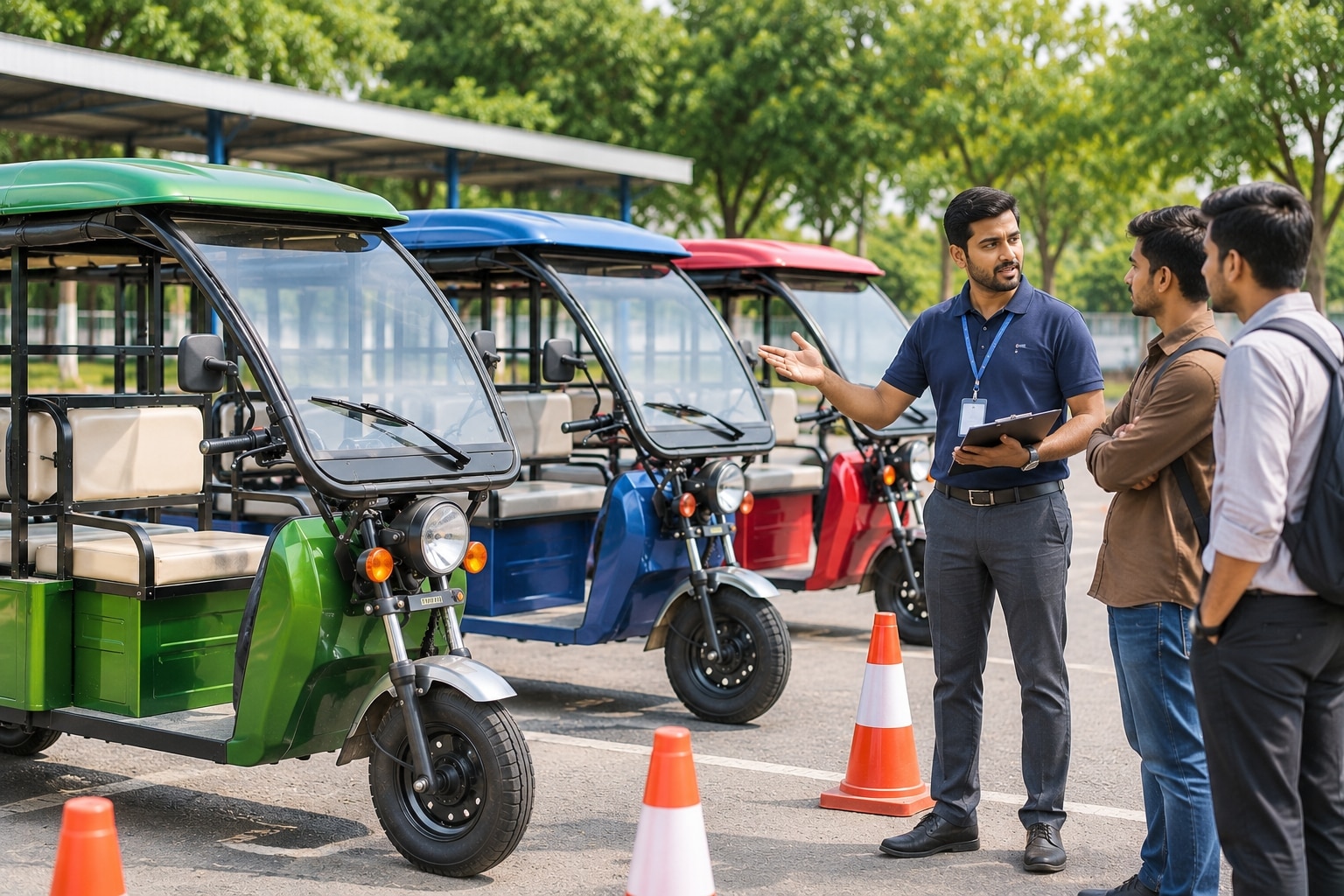
Before road driving, an e-rickshaw course should teach traffic rules and the exact controls of the vehicle you will operate. Familiarisation helps you recognise a fault; it does not replace supervised driving.
1. Classroom lessons should cover traffic signs, right-of-way, lane discipline, speed control, stopping distance, and protection of pedestrians, cyclists, children and older people. Explain the commercial passenger driver’s duties: safe boarding, lawful loading, passenger care and compliance with directions.
2. On the actual model, practise the accelerator, forward/reverse selector, service brake, parking brake, horn, indicators, headlamps, mirrors, windshield wiper where fitted, battery-state display, charging indicator and emergency cut-off or main switch. Controls differ between models, so the instructor must identify each one rather than assume familiarity.
3. Follow a daily inspection sequence: check tyre condition and pressure, wheel nuts, steering play, brake operation, lights, indicators, horn, mirrors, passenger handholds, battery connections and parking-brake condition. Record or report a defect before carrying passengers.
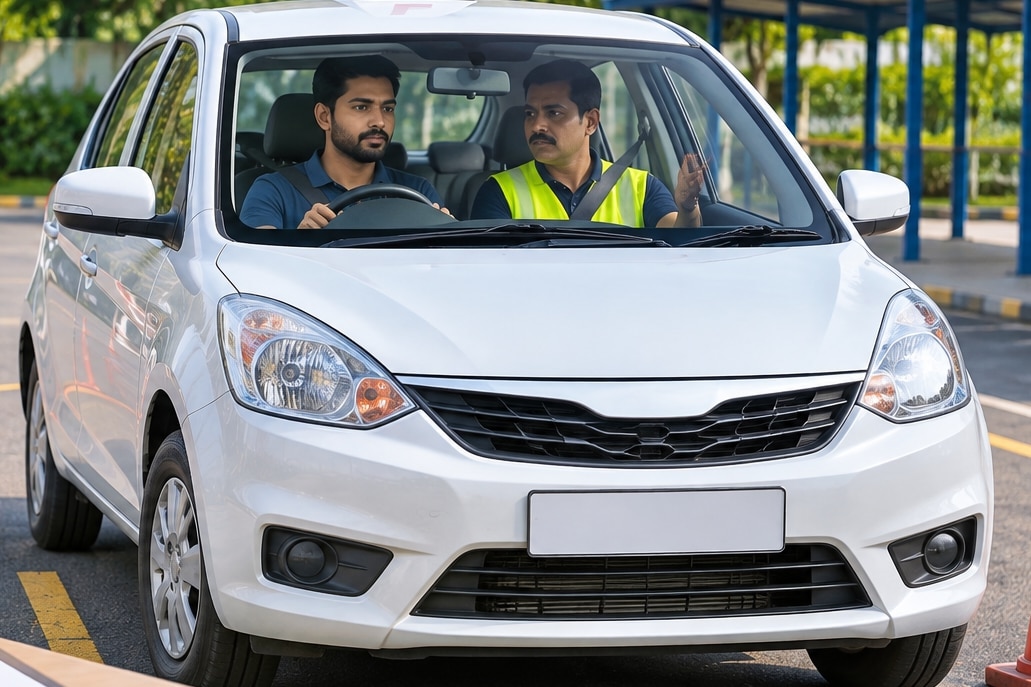
4. Confirm that the e rickshaw course details include supervised starts, stops and road driving after familiarisation. Mechanical repair training is a separate inclusion; checking connections is not repairing a motor, brake or battery fault.
Which manoeuvres and passenger-loading exercises belong in practical training?
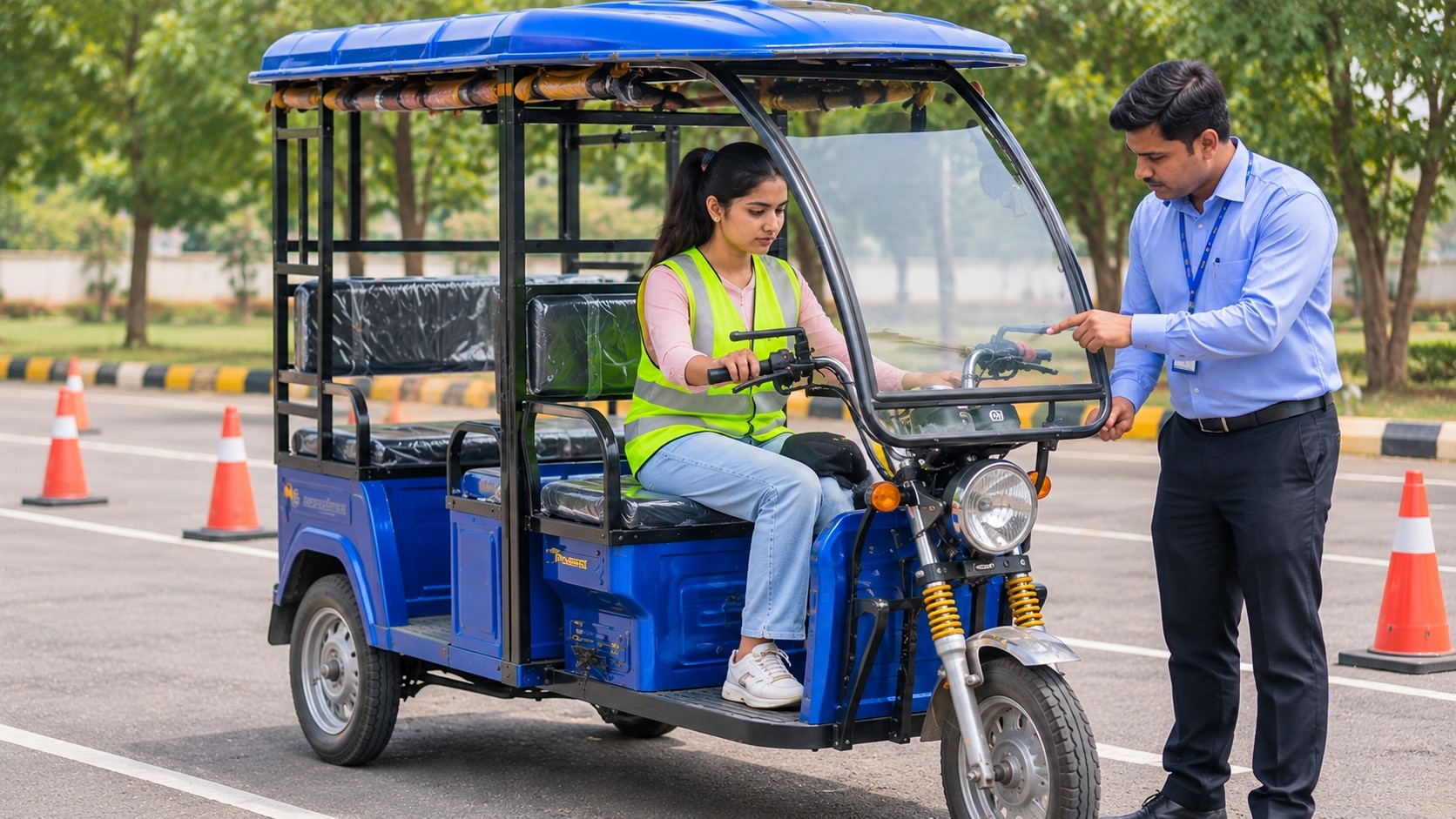
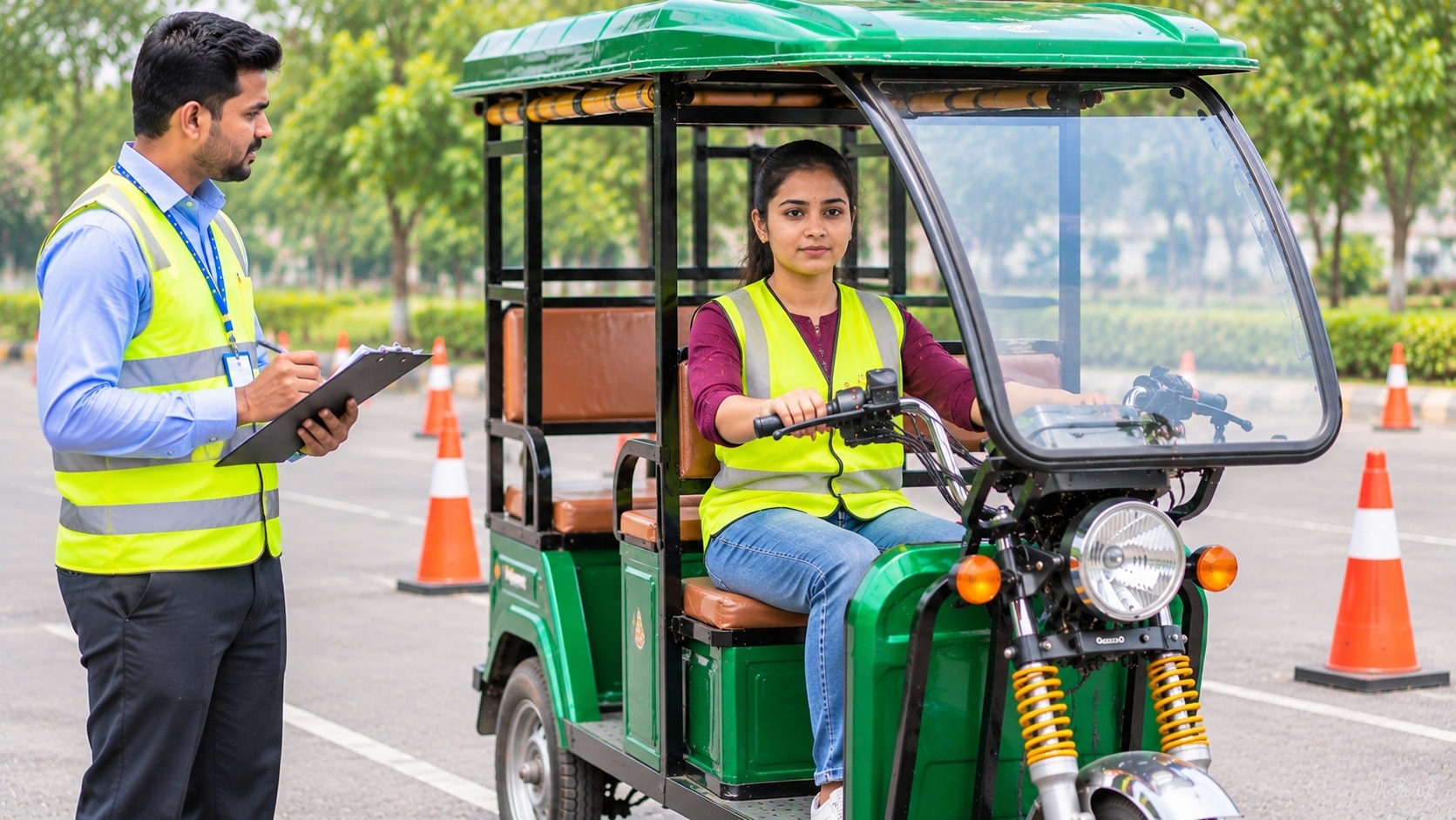
Hands-on practice belongs on a closed ground before public-road driving, with each exercise repeated until control is smooth. A high, rear-heavy passenger load changes stability during turns and braking, so an empty vehicle does not reveal every risk.
- Start and stop smoothly without jerking.
- Control steering through left and right turns, judge turning radius, and complete U-turns.
- Reverse in a straight line and around a marked corner.
- Park accurately, perform hill starts, and manoeuvre through a narrow lane.
- Apply controlled emergency braking without losing steering control.
Passenger simulation must use the permitted seating and luggage arrangement. Keep every passenger inside the designated body, secure loose items, and refuse overloading. Practise boarding and alighting from the kerb side only, wait until the e-rickshaw is fully stopped, and use a safe speed near waiting passengers.
Children and elderly passengers need extra care because a hurried step can become a fall.
Ask these questions before enrolment:
| Question | What a clear answer includes | Why it matters |
|---|---|---|
| Is training one-to-one? | Dedicated instructor time or a stated group size | Reveals how much individual practice you receive |
| How much practice is provided? | Number of sessions or hours | “Course completed” otherwise says little |
| What safety control is used? | Instructor brake or another explained control | Limits risk during early exercises |
| What is assessed? | Named manoeuvres and scoring, plus any mock test | Shows whether competence is actually checked |
What battery, charging and breakdown safety is taught?
A complete lesson teaches charging and emergency decisions, not just how to move the e-rickshaw. The instructor must use the vehicle’s manual for charger type, indicator meanings and the charging time stated for that model.
1. Inspect the charger plug, socket and cable before use. With the vehicle switched off, connect the charger in the manufacturer’s stated order, then switch on the supply; disconnect the supply first, then remove the vehicle plug. Charge only in a dry, ventilated place without makeshift extensions, damaged wiring or combustible materials.
2. Read the charging indicator and stop at the specified completion point. For lead-acid batteries, check battery water only by the manufacturer’s procedure; never add tap water or open a hot battery.
3. Treat reduced acceleration, dimming lights and a battery-warning display as low-charge signs. Stop safely if power disappears, switch off non-essential loads, warn other road users and arrange assistance.
4. Stop charging or driving after abnormal heat, smell, smoke, swelling or damaged wiring. Isolate the vehicle before any electrical troubleshooting.
5. For reduced braking, a puncture, collision, passenger fall or injury, or a stranded vehicle, secure the scene, summon emergency help and protect passengers from traffic. Do not continue the trip or attempt an improvised repair.
How should supervised road driving prepare you for Noida traffic?
Public-road driving should begin after closed-ground practice because traffic leaves no room to learn basic control. Routes should build lane positioning, safe gap selection, signalling before pulling away, blind-area checks and merges; an e-rickshaw’s low speed does not remove the need to judge gaps or yield correctly.
- Practise speed breakers, parked vehicles, pedestrians, cyclists, motorcycles and buses. Hold a predictable line, avoid abrupt swerves and scan for opening doors before passing parked cars.
- Add U-turns, roundabouts, unmarked intersections, congested markets, school zones and passenger stands. Signal before pulling out, check blind areas and merge only when the gap remains safe.
- Include night or reduced-visibility driving when conditions are safe and lawful. Use the correct lights, reduce speed and extend the gap rather than relying on other drivers to see you.
- Apply passenger safeguards on every route: keep passengers seated, prevent boarding or alighting until the vehicle has completely stopped, and wait for a clear kerb-side movement.
This exposure turns manoeuvres into decisions made around real people and vehicles. A learner comparing e rickshaw training noida providers should ask whether route practice includes supervised traffic exposure, not only an empty-ground session.
Treat noida driving training as a practical question: where does driving take place, at what traffic levels and in which conditions? A provider that cannot state its routes, supervision method and lawful limits leaves a major part of preparation untested.
Which documents, assessments and course promises should you verify before enrolment?
A driving licence and permission to carry passengers commercially are different things. Ask an e rickshaw driving school which vehicle category appears in the licensing system and on the registration certificate; an electric-scooter category is not automatically valid for an e-rickshaw.
| Check | Ask for or verify | What it prevents |
|---|---|---|
| Applicant documents | Learner-licence application help, permanent-licence appointment, identity and age documents, medical or eyesight checks | Rejected applications |
| Vehicle and operation | Registration, insurance, pollution certificate, fitness, permit, route or stand permissions, and Uttar Pradesh and local commercial-driver obligations | Illegal passenger operation |
| Vehicle category | Three wheels, design speed up to 25 km/h, motor power up to 2 kW, up to four passengers excluding the driver, and the permitted luggage limit | Training on the wrong vehicle |
| Course delivery | Sessions or hours, one-to-one practice, instructor brake or other safety control, scored manoeuvres and assessment method | Vague “course completed” claims |
| Completion support | Mock official test, completion certificate, refresher lessons and test-booking assistance | Unexpected exclusions |
Request every inclusion in writing. Ask whether vehicle rental, repairs, battery replacement, insurance or permit procurement costs extra. Noida driving school e rickshaw training for inclusions should be your comparison checklist, not an assumption based on an advertisement.
Om Sai Motor Driving Training School can be compared with other providers using these questions. A school may help prepare documents and tests, but it cannot guarantee licence approval or replace the licensing authority.
Related service
E-Rickshaw Training Om Sai Motor Driving Training School offers specialized E-Rickshaw Training designed for safe, efficient, and professional driving. View service → |
Frequently asked questions
What should classroom and vehicle familiarisation include in e-rickshaw training?
The course should cover traffic rules, vehicle controls, mirrors, brakes, indicators, steering, parking controls and basic fault recognition before road driving.
Which practical exercises belong in an e-rickshaw course?
Look for supervised starts and stops, reversing, turns, U-turns, parking, narrow-space manoeuvres, emergency braking and safe passenger loading and unloading.
What battery and charging safety should an e-rickshaw driver learn?
Training should explain the battery type, charging procedure, ventilation, cable and connector checks, electrical warning signs, fire response and safe breakdown steps.
How should supervised road driving prepare you for Noida traffic?
Practice should cover junctions, mixed traffic, pedestrians, cyclists, speed control, lane positioning, roadside stops and route decisions under instructor supervision.
What should you verify before enrolling in an e-rickshaw driving school?
Ask for course duration, practical hours, vehicle access, instructor supervision, assessment method, licence support, fees, cancellation terms and written promises.