
Age alone does not automatically prevent you from pursuing transport-vehicle driving in Uttar Pradesh, but heavy-vehicle training places greater demands on vision, mobility, reaction time, stamina and judgement than ordinary car driving. You will be able to check your medical and licence readiness, compare vehicle-specific training, and select a safer course structure for your experience level.
Key takeaways
- Complete the transport-licence medical examination, commonly using Form 1A.
- Confirm Uttar Pradesh licence steps before booking HMV lessons.
- Choose shorter lessons, planned rest breaks, and gradual vehicle progression.
- Compare instructor experience, vehicle condition, yard space, and safety procedures.
Can an older driver begin HMV training safely?
Age alone does not set a general upper cut-off for transport-vehicle driving. Medical fitness is the starting point for HMV training for older drivers, so arrange the prescribed transport-licence medical process, commonly Form 1A, through the current Uttar Pradesh licensing procedure and confirm the examination requirements before paying for lessons.
A basic eyesight check is not a complete fitness assessment. Ask about visual acuity, field of vision, hearing, neck and shoulder movement, sleep disorders, diabetes-related episodes, cognitive changes and medication effects. A passed vision check cannot prove that you can control a heavy vehicle safely.
Before enrolment, test the physical demands with a qualified instructor or clinician:
- Climb into and out of a high cab without losing balance.
- Adjust the mirrors and maintain a clear view.
- Operate the clutch and gear lever through their full range.
- Turn the steering wheel comfortably in both directions.
- Sit in the driving position for a sustained period without significant pain.
- Perform an emergency-braking movement quickly and firmly.
Discuss sedating antihistamines, sleep medicines, certain pain medicines and low-blood-sugar risks with your doctor or pharmacist. Do not stop prescribed treatment independently. If fatigue, dizziness or reduced reaction speed appears, the school should recommend medical review or shorten, pause or otherwise alter the lesson plan.
What is the Uttar Pradesh licence path for a heavy vehicle?
The route starts with the job, not the label “HMV.” That term is used by driving schools and searchers; the legal class depends on the vehicle, such as a heavy goods vehicle, heavy passenger motor vehicle, goods carriage, bus, school bus or private-service vehicle.
The minimum age for a transport vehicle is 20. Age alone does not create an automatic upper limit, so an older applicant is considered through medical fitness, licence-renewal rules and the Uttar Pradesh licensing authority’s procedure.
| Vehicle class | Typical work | What to confirm |
|---|---|---|
| Heavy goods vehicle | Truck or goods carriage | Gross-vehicle-weight range and licence class |
| Heavy passenger vehicle | Bus or school bus | Passenger-vehicle category and route requirements |
| Other transport vehicle | Private-service vehicle | Exact legal class and vehicle documents |
Follow this order:
- Name the intended job and exact vehicle, including whether it is rigid, multi-axle or articulated.
- Apply for the appropriate learner’s licence through the Uttar Pradesh process.
- Submit the identity, address, existing-licence and vehicle-related documents the authority requests.
- Confirm whether Form 1A, the transport-licence medical certificate, is required and how the examination must be completed.
- Book the licensing-authority appointment and take the practical driving test.
A course certificate from a heavy vehicle driving school noida does not replace the learner’s licence, appointment or government test. Ask whether the school helps prepare documents and schedule the test, while recognising that only the licensing authority decides approval.
How should lessons change for an older learner?
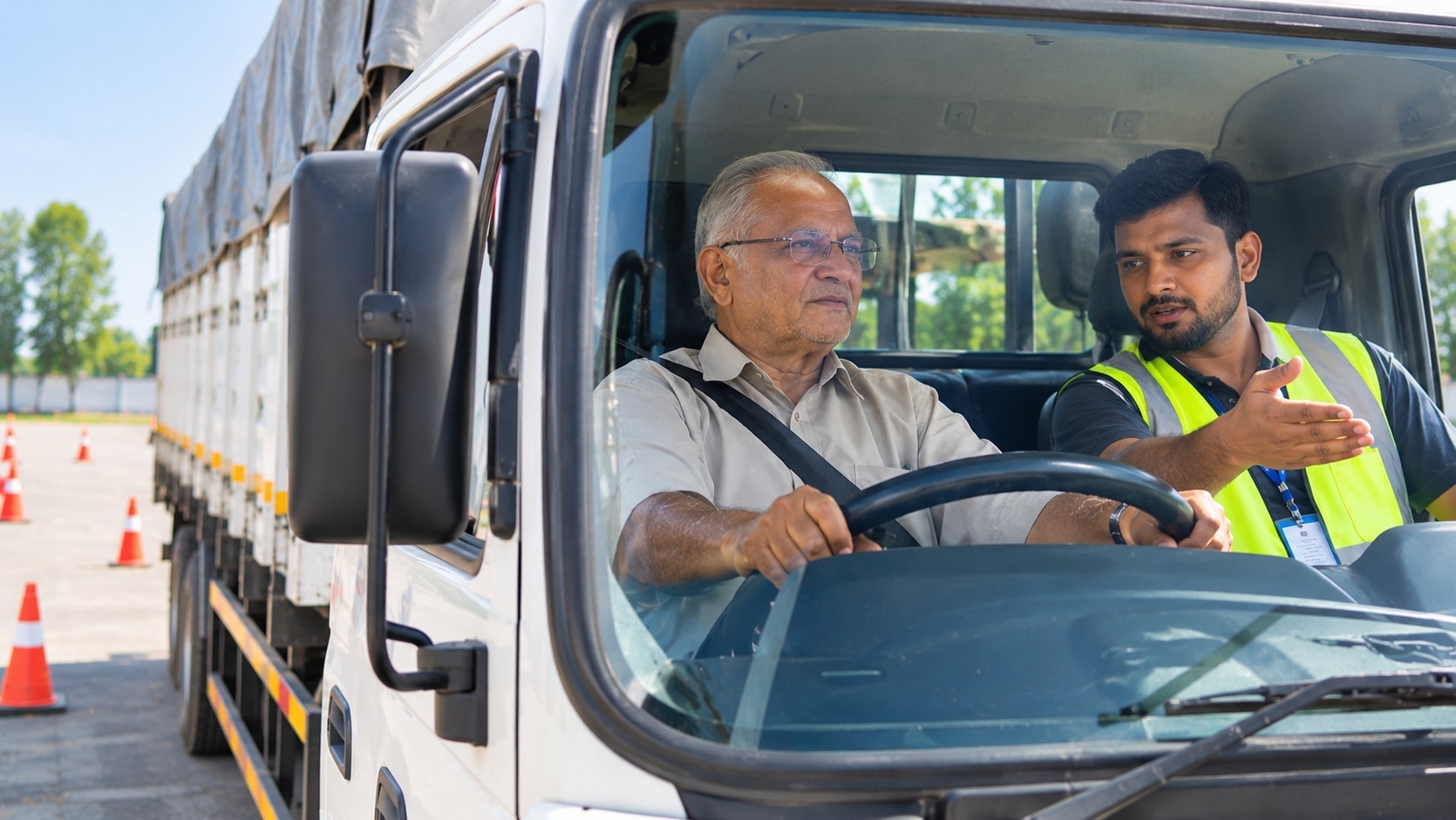
Begin HMV training for older drivers with a low-speed assessment, not a long road trip. Use shorter sessions with planned rest breaks, then progress from cab entry and controls to closed-ground manoeuvres and public roads. Fatigue can conceal poor control and lengthen reaction time, so longer lessons are not automatically better.
1. Familiarise yourself with seat and mirror adjustment, steering effort, clutch bite point, gear range, air-pressure warnings and the stopping feel of air brakes before entering traffic.
2. Repeat reversing, narrow gates, parking, left turns, mirror-scan routines, blind-zone checks, emergency braking and controlled descents. Add coupling and uncoupling when the intended job involves a trailer.
3. Progress only when the current task is consistent. Ask for extra practice without embarrassment, and stop the lesson when you become drowsy or lose concentration.
4. Watch for delayed pedal responses, missed mirrors, repeated gear-selection errors, shoulder or knee pain, drowsiness and reduced concentration. These signs matter more than completing a planned number of hours.
5. Record progress by task: reversing accuracy, gate clearance, stopping control, mirror use and descent management. A completed lesson is not proof of competence.
The instructor should pause or modify training when warning signs appear, rather than treating them as ordinary ageing. Discuss sedating medicines, sleep medicines, certain pain medicines and low-blood-sugar risks with a clinician or pharmacist before lessons; do not stop prescribed treatment independently.
Which vehicle and course type match your experience?
A long driving gap calls for an LMV refresher before heavy-vehicle lessons; a short familiarisation session suits an experienced driver changing vehicle type, not someone entering commercial driving for the first time.
| Course choice | Best match | What you practise |
|---|---|---|
| LMV refresher | Driver returning after a long gap | Car control, observation, mirror use and traffic judgement |
| HMV familiarisation | Experienced driver changing vehicle or returning after a gap | Cab controls, dimensions, air brakes, reversing and vehicle-specific handling |
| First-time commercial training | Learner with no professional driving history | Workplace checks, load responsibility, fatigue control, route risk and licence-test skills |
| Vehicle | Main handling difference |
|---|---|
| Rigid truck | Longer wheelbase, wide turning path, tail swing, high cab and large blind zones |
| Bus | Passenger load changes weight distribution; mirrors and rear overhang demand constant scanning |
| Multi-axle vehicle | Extra axles alter turning path, tyre tracking, braking feel and clearance |
| Articulated combination | Trailer swing, separate axle groups and coupling movement complicate reversing and turns |
An unloaded rigid truck does not prepare you automatically for passengers, cargo or a trailer. Transmission type, axle count, wheelbase and air-brake behaviour all change the task.
A first-time commercial driver needs training in:
- Pre-trip inspection, tyres, wheel nuts, lights, mirrors and air-system warnings
- Load security and defect reporting
- Emergency stopping, fatigue management and route-risk assessment
Tell a commercial driving school Noida the exact job and vehicle category before enrolling. An experienced driver returning after a gap may need both an LMV refresher and vehicle-specific HMV training.
How do you assess a heavy-vehicle school in Noida?
A credible heavy vehicle driving school in Noida will show evidence, not just promise “HMV training.” Compare each school against the vehicle, job and licence category you intend to pursue.
1. Ask to see the school’s authorisation, written syllabus, instructor qualifications, vehicle registration and fitness certificates, insurance policy and maintenance records.
2. Inspect the training vehicle. Confirm that it matches your intended rigid truck, bus, multi-axle vehicle or articulated combination, with clear mirrors, effective brakes, adjustable seating and any dual-control arrangement suitable for that vehicle.
3. Ask for the instructor-to-learner ratio, closed-ground practice area, planned Noida road routes, expected traffic density, lesson length, rest-break policy and emergency procedure.
4. Require a clear answer about who takes control during danger, how mechanical defects are reported and what happens when fatigue, slow reactions or loss of concentration appears.
5. Check that lessons include reversing, pre-trip checks, load-related handling, air-brake warnings, night or low-visibility risk discussion and emergency stopping. Ask how the school prepares you for the licensing-authority test, without confusing coaching or a training certificate with licence approval.
6. Prefer a school that permits slower progression and records skills needing more practice. Om Sai Motor Driving Training School is worth comparing on that basis, only if its vehicle and lesson structure match your goal.
A commercial driving school in Noida earns confidence by documenting progress rather than rushing every learner through a fixed number of sessions. Reject vague answers, unavailable records and vehicles that differ materially from the one you will drive at work.
Frequently asked questions
Can an older driver begin HMV training safely?
Yes, if the driver passes the prescribed transport-licence medical examination and can manage the vehicle’s physical and visual demands. Arrange the current Uttar Pradesh medical process, commonly Form 1A, before paying for lessons.
What is the Uttar Pradesh licence path for a heavy vehicle?
Confirm the current Uttar Pradesh transport-licence process, complete the required medical examination, meet eligibility conditions, obtain learner authorisation where required, and pass the heavy-vehicle driving test.
How should lessons change for an older learner?
Use shorter sessions, planned rest breaks, gradual skill progression, repeated mirror and blind-spot checks, and extra practice for braking, reversing, turns, and vehicle dimensions.
How do you assess a heavy-vehicle school in Noida?
Inspect the training vehicle, ask about instructor experience, check the practice area, verify lesson structure, and request clear information about licence paperwork and test preparation.